Free Demo


Nowadays, worldwide news is being circulated quickly (P1 - Management Accounting Question Tutorial exam questions). It is more and more convenient to obtain the useful part to improve our ability and master the opportunity. We conform to the trend of the time and designed the most professional and effective P1 - Management Accounting Question Tutorial study materials for exam candidates aiming to pass exam at present, which is of great value and gain excellent reputation around the world, so here we highly commend this P1 - Management Accounting Question Tutorial dumps torrent to you. Now let us take a whole look of the details as follows:

Considerate aftersales 24/7
Our employees are lavish in helping clients about their problems of the P1 - Management Accounting Question Tutorial dumps torrent 24/7.because we actually have the identical aim of passing the test with efficiency. Once you buy the P1 - Management Accounting Question Tutorial study materials, you can directly download materials within 10 minutes and begin your preparation without waiting problems. The former customers who bought P1 - Management Accounting Question Tutorial exam questions in our company all impressed by the help of the CIMA P1 - Management Accounting Question Tutorial dumps torrent and our aftersales services. If you have some other questions, ask for our aftersales agent, they will solve the problems 24/7 for you as soon as possible, so you can place your order assured and trusted.
After purchase, Instant Download: Upon successful payment, Our systems will automatically send the product you have purchased to your mailbox by email. (If not received within 12 hours, please contact us. Note: don't forget to check your spam.)
Reliable P1 - Management Accounting Question Tutorial exam preparatory
We build lasting and steady relationship with a group of clients, they not only give us great feedbacks, but order the second purchases later with confidence toward our products, and recommend our P1 - Management Accounting Question Tutorial exam questions to people around them who need the exam materials. Our P1 - Management Accounting Question Tutorial study materials are the best choice for you to imitate as the real test exam materials. As long as you are accustomed to the pattern and content of the P1 - Management Accounting Question Tutorial dumps torrent, when confronting the real test, you will feel just like a fish in water whatever the difficulties they are, and these are good feedback collected from the former customers.
We build close relationships with customers who come from many countries around the world and win great reputation, so you can totally trust us and our P1 - Management Accounting Question Tutorial exam questions. Before you buying the P1 - Management Accounting Question Tutorial study materials, we provide free demos at the under page of products, you can download experimentally and have a try. Once you decided to place your order, we provide the easiest way for you to buy P1 - Management Accounting Question Tutorial dumps torrent within 10 minutes.
Efficient content with great reputation
A group of experts and certified trainers who dedicated to the P1 - Management Accounting Question Tutorial dumps torrent for many years, so the exam materials are totally trusted. What is more, you do not need to spare much time to practice the P1 - Management Accounting Question Tutorial exam questions, just 20 to 30 hours will be enough, and you can take advantage of leisure time to pass the test with least time and money. So even if you are busy in working, spend the idle time on our exam materials regularly still can pass the CIMA P1 - Management Accounting Question Tutorial exam successfully. An extremely important point of the P1 - Management Accounting Question Tutorial dumps torrent is their accuracy and preciseness, so our P1 - Management Accounting Question Tutorial study materials are totally valid. Besides, our experts also keep up with the trend of development to add the new points into the P1 - Management Accounting Question Tutorial exam questions timely, which mean you can always get the newest information.
CIMA CIMAPRO15-P01-X1-ENG Exam Syllabus Topics:
| Section | Weight | Objectives |
|---|---|---|
| Topic 1: Short-Term Commercial Decision Making | 30% | - Pricing decisions - Make-or-buy and outsourcing decisions - Relevant costing principles - Limiting factor decisions - Cost-volume-profit analysis |
| Topic 2: Budgeting and Budgetary Control | 25% | - Purpose and types of budgets - Budget preparation techniques - Beyond budgeting and modern approaches - Flexible budgets and budget variances |
| Topic 3: Cost Accounting for Decision and Control | 30% | - Costing concepts and terminology - Activity-based costing (ABC) - Throughput, target and lifecycle costing - Standard costing and variance analysis - Absorption and marginal costing |
| Topic 4: Dealing with Uncertainty in the Short Term | 15% | - Risk and uncertainty concepts - Decision trees and decision criteria - Sensitivity and scenario analysis - Expected value and probability analysis |
CIMA P1 - Management Accounting Question Tutorial Sample Questions:
TP makes wedding cakes that are sold to specialist retail outlets which decorate the cakes according to the customers' specific requirements. The standard cost per unit of its most popular cake is as follows: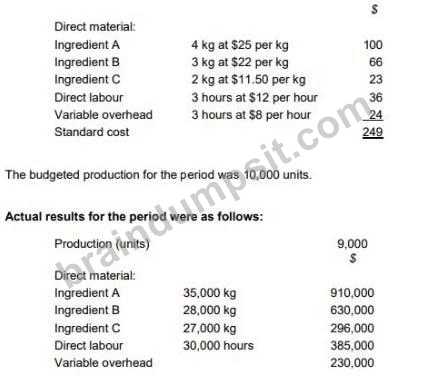
The general market prices at the time of purchase for Ingredient A and Ingredient B were $23 per kg and $20 per kg respectively. TP operates a JIT purchasing system for ingredients and a JIT production system; therefore, there was no inventory during the period.
What was the material yield variance?
- A. The material yield variance was $175 000 A
- B. The material yield variance was $175 500 A
- C. The material yield variance was $155 000 A
- D. The material yield variance was $98 500 A
- E. The material yield variance was $155 500 A
Correct Answer: A 🗳️
RT produces two products from different quantities of the same resources using a just-in-time (JIT) production system. The selling price and resource requirements of each of the products are shown below: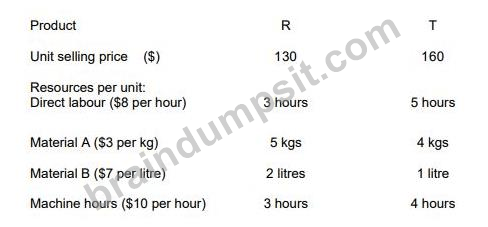
Market research shows that the maximum demand for products R and T during June 2010 is 500 units and
800 units respectively. This does not include an order that RT has agreed with a commercial customer for the supply of 250 units of R and 350 units of T at selling prices of $100 and $135 per unit respectively. Although the customer will accept part of the order, failure by RT to deliver the order in full by the end of June will cause RT to incur a $10,000 financial penalty. At a recent meeting of the purchasing and production managers to discuss the production plans of RT for June, the following resource restrictions for June were identified:
Direct labour hours 7,500 hours
Material A 8,500 kgs
Material B 3,000 litres
Machine hours 7,500 hours
Assuming that RT completes the order with the commercial customer, prepare calculations to show, from a financial perspective, the optimum production plan for June 2010 and the contribution that would result from adopting this plan.
The contribution per unit for R and T will be...?
- A. R = $47 per unit. T = $65 per unit
- B. R = $47 per unit. T = $61 per unit
- C. R = $45 per unit. T = $66 per unit
- D. R = $51 per unit. T = $61 per unit
Correct Answer: B 🗳️
Explanation: Only visible for BraindumpsIT members. You can sign-up / login (it's free).
A medium-sized manufacturing company, which operates in the electronics industry, has employed a firm of consultants to carry out a review of the company's planning and control systems. The company presently uses a traditional incremental budgeting system and the inventory management system is based on economic order quantities (EOQ) and reorder levels. The company's normal production patterns have changed significantly over the previous few years as a result of increasing demand for customized products. This has resulted in shorter production runs and difficulties with production and resource planning.
The consultants have recommended the implementation of activity based budgeting and a manufacturing resource planning system to improve planning and resource management.
How will a manufacturing resource planning system improve the planning of purchases and production for the company?
Select ALL the correct answers.
- A. A manufacturing resource planning approach to the management of all the company's manufacturing
resources including inventory, labour and machine capacity. - B. It seeks to ensure that resources are available just before they are needed by the next stage of production or dispatch. It also seeks to ensure that resources are delivered only when required so that raw material inventory is kept to a minimum.
- C. The correct inventory management system relies on the assumption that there is constant demand. An MRP system begins with the setting of a master production schedule specifying both the timing and quantity demanded of each of the finished goods items and then works backwards to determine the resource requirements at each stage of the production process.
- D. The technique will not enable managers to track orders through the manufacturing process and will not assist the purchasing and production control departments to move the right amount of material or sub- assemblies at the right time to the right place.
- E. It aims to generate an estimation of materials requirements after taking account of the number of employees quality and waste. The TQS model can be used within MRP provided that the major assumption in the TQS model of constant demand applies.
- F. The traditional approach to determine material requirements is to monitor inventories constantly; whenever they fall to a predetermined level, a preset order is placed to replenish them. This traditional approach (involving re-order levels and economic order quantity calculations originates in the pre-computer era.
Correct Answer: A,B,C,F 🗳️
Explanation: Only visible for BraindumpsIT members. You can sign-up / login (it's free).
RFT, an engineering company, has been asked to provide a quotation for a contract to build a new engine.
The potential customer is not a current customer of RFT, but the directors of RFT are keen to try and win the contract as they believe that this may lead to more contracts in the future. As a result, they intend pricing the contract using relevant costs. The following information has been obtained from a two-hour meeting that the Production Director of RFT had with the potential customer. The Production Director is paid an annual salary equivalent to $1,200 per 8-hour day. 110 square meters of material A will be required. This is a material that is regularly used by RFT and there are 200 square meters currently in inventory. These were bought at a cost of
$12 per square meter. They have a resale value of $10.50 per square meter and their current replacement cost is $12.50 per square meter. 30 liters of material B will be required. This material will have to be purchased for the contract because it is not otherwise used by RFT. The minimum order quantity from the supplier is 40 liters at a cost of $9 per liter. RFT does not expect to have any use for any of this material that remains after this contract is completed. 60 components will be required. These will be purchased from HY. The purchase price is $50 per component. A total of 235 direct labour hours will be required. The current wage rate for the appropriate grade of direct labour is $11 per hour. Currently RFT has 75 direct labour hours of spare capacity at this grade that is being paid under a guaranteed wage agreement. The additional hours would need to be obtained by either (i) overtime at a total cost of $14 per hour; or (ii) recruiting temporary staff at a cost of $12 per hour. However, if temporary staff are used they will not be as experienced as RFT's existing workers and will require 10 hours supervision by an existing supervisor who would be paid overtime at a cost of $18 per hour for this work. 25 machine hours will be required. The machine to be used is already leased for a weekly leasing cost of $600. It has a capacity of 40 hours per week. The machine has sufficient available capacity for the contract to be completed. The variable running cost of the machine is $7 per hour. The company absorbs its fixed overhead costs using an absorption rate of $20 per direct labour hour.
Select ALL the true statements.
- A. Material A was a relevant cost.
- B. The machine is currently being leased and it has spare capacity so it will either stand idle or be used on this work. The lease cost will be a relevant cost or $10 per hour.
- C. The relevant cost is $7080
- D. The components are to be purchased from HY at a cost of $50 each. This is a relevant cost because it is future expenditure that will be incurred as a result of the work being undertaken.
- E. Material B was a relevant cost.
- F. The relevant cost is $7100
- G. The cost for the production director meeting was a relevant cost.
- H. The relevant cost is $7010
- I. The company absorbs its fixed overhead costs using an absorption rate of $20 per direct labour hour. This is a relevant cost.
Correct Answer: A,D,E,H 🗳️
Explanation: Only visible for BraindumpsIT members. You can sign-up / login (it's free).
A major company sells a range of electrical, clothing and homeware products through a chain of department stores. The main administration functions are provided from the company's head office. Each department store has its own warehouse which receives goods that are delivered from a central distribution center.
The company currently measures profitability by product group for each store using an absorption costing system. All overhead costs are charged to product groups based on sales revenue. Overhead costs account for approximately one-third of total costs and the directors are concerned about the arbitrary nature of the current method used to charge these costs to product groups.
A consultant has been appointed to analyses the activities that are undertaken in the department stores and to establish an activity based costing system.
The consultant has identified the following data for the latest period for each of the product groups for the X Town store: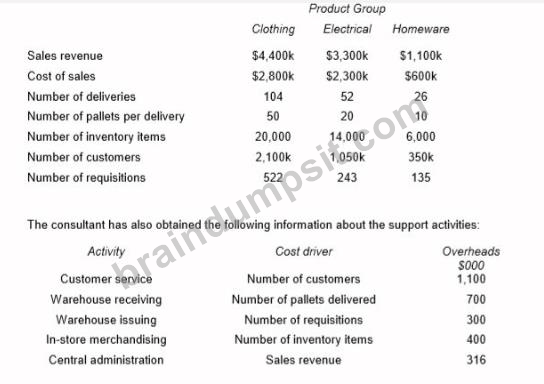
Calculate the total profit for each of the product groups:
.... using the current absorption costing system;
- A. The profit or loss in $ was.... Clothing 85; Electrical 36; Homeware (28)
- B. The profit or loss in $ was.... Clothing (175); Electrical 86; Homeware 22
- C. The profit or loss in $ was.... Clothing 122; Electrical 56; Homeware (178)
- D. The profit or loss in $ was.... Clothing 192; Electrical (56); Homeware 148
Correct Answer: D 🗳️
Explanation: Only visible for BraindumpsIT members. You can sign-up / login (it's free).