


100% Real & Accurate Databricks-Generative-AI-Engineer-Associate Questions and Answers with Free and Fast Updates
Get Unlimited Access to Databricks-Generative-AI-Engineer-Associate Certification Exam Cert Guide
Databricks Databricks-Generative-AI-Engineer-Associate Exam Syllabus Topics:
| Topic | Details |
|---|---|
| Topic 1 |
|
| Topic 2 |
|
| Topic 3 |
|
| Topic 4 |
|
| Topic 5 |
|
NEW QUESTION # 38
A Generative Al Engineer is building a RAG application that answers questions about internal documents for the company SnoPen AI.
The source documents may contain a significant amount of irrelevant content, such as advertisements, sports news, or entertainment news, or content about other companies.
Which approach is advisable when building a RAG application to achieve this goal of filtering irrelevant information?
- A. Include in the system prompt that the application is not supposed to answer any questions unrelated to SnoPen Al.
- B. Consolidate all SnoPen AI related documents into a single chunk in the vector database.
- C. Keep all articles because the RAG application needs to understand non-company content to avoid answering questions about them.
- D. Include in the system prompt that any information it sees will be about SnoPenAI, even if no data filtering is performed.
Answer: A
Explanation:
In a Retrieval-Augmented Generation (RAG) application built to answer questions about internal documents, especially when the dataset contains irrelevant content, it's crucial to guide the system to focus on the right information. The best way to achieve this is byincluding a clear instruction in the system prompt(option C).
* System Prompt as Guidance:The system prompt is an effective way to instruct the LLM to limit its focus to SnoPen AI-related content. By clearly specifying that the model should avoid answering questions unrelated to SnoPen AI, you add an additional layer of control that helps the model stay on- topic, even if irrelevant content is present in the dataset.
* Why This Approach Works:The prompt acts as a guiding principle for the model, narrowing its focus to specific domains. This prevents the model from generating answers based on irrelevant content, such as advertisements or news unrelated to SnoPen AI.
* Why Other Options Are Less Suitable:
* A (Keep All Articles): Retaining all content, including irrelevant materials, without any filtering makes the system prone to generating answers based on unwanted data.
* B (Include in the System Prompt about SnoPen AI): This option doesn't address irrelevant content directly, and without filtering, the model might still retrieve and use irrelevant data.
* D (Consolidating Documents into a Single Chunk): Grouping documents into a single chunk makes the retrieval process less efficient and won't help filter out irrelevant content effectively.
Therefore, instructing the system in the prompt not to answer questions unrelated to SnoPen AI (option C) is the best approach to ensure the system filters out irrelevant information.
NEW QUESTION # 39
A Generative Al Engineer has already trained an LLM on Databricks and it is now ready to be deployed.
Which of the following steps correctly outlines the easiest process for deploying a model on Databricks?
- A. Wrap the LLM's prediction function into a Flask application and serve using Gunicorn
- B. Log the model as a pickle object, upload the object to Unity Catalog Volume, register it to Unity Catalog using MLflow, and start a serving endpoint
- C. Save the model along with its dependencies in a local directory, build the Docker image, and run the Docker container
- D. Log the model using MLflow during training, directly register the model to Unity Catalog using the MLflow API, and start a serving endpoint
Answer: D
Explanation:
* Problem Context: The goal is to deploy a trained LLM on Databricks in the simplest and most integrated manner.
* Explanation of Options:
* Option A: This method involves unnecessary steps like logging the model as a pickle object, which is not the most efficient path in a Databricks environment.
* Option B: Logging the model with MLflow during training and then using MLflow's API to register and start serving the model is straightforward and leverages Databricks' built-in functionalities for seamless model deployment.
* Option C: Building and running a Docker container is a complex and less integrated approach within the Databricks ecosystem.
* Option D: Using Flask and Gunicorn is a more manual approach and less integrated compared to the native capabilities of Databricks and MLflow.
OptionBprovides the most straightforward and efficient process, utilizing Databricks' ecosystem to its full advantage for deploying models.
NEW QUESTION # 40
A Generative AI Engineer is designing a chatbot for a gaming company that aims to engage users on its platform while its users play online video games.
Which metric would help them increase user engagement and retention for their platform?
- A. Randomness
- B. Repetition of responses
- C. Lack of relevance
- D. Diversity of responses
Answer: D
Explanation:
In the context of designing a chatbot to engage users on a gaming platform, diversity of responses (option B) is a key metric to increase user engagement and retention. Here's why:
Diverse and Engaging Interactions:
A chatbot that provides varied and interesting responses will keep users engaged, especially in an interactive environment like a gaming platform. Gamers typically enjoy dynamic and evolving conversations, and diversity of responses helps prevent monotony, encouraging users to interact more frequently with the bot.
Increasing Retention:
By offering different types of responses to similar queries, the chatbot can create a sense of novelty and excitement, which enhances the user's experience and makes them more likely to return to the platform.
Why Other Options Are Less Effective:
A (Randomness): Random responses can be confusing or irrelevant, leading to frustration and reducing engagement.
C (Lack of Relevance): If responses are not relevant to the user's queries, this will degrade the user experience and lead to disengagement.
D (Repetition of Responses): Repetitive responses can quickly bore users, making the chatbot feel uninteresting and reducing the likelihood of continued interaction.
Thus, diversity of responses (option B) is the most effective way to keep users engaged and retain them on the platform.
NEW QUESTION # 41
A Generative Al Engineer is tasked with developing an application that is based on an open source large language model (LLM). They need a foundation LLM with a large context window.
Which model fits this need?
- A. DBRX
- B. Llama2-70B
- C. MPT-30B
- D. DistilBERT
Answer: B
Explanation:
* Problem Context: The engineer needs an open-source LLM with a large context window to develop an application.
* Explanation of Options:
* Option A: DistilBERT: While an efficient and smaller version of BERT, DistilBERT does not provide a particularly large context window.
* Option B: MPT-30B: This model, while large, is not specified as being particularly notable for its context window capabilities.
* Option C: Llama2-70B: Known for its large model size and extensive capabilities, including a large context window. It is also available as an open-source model, making it ideal for applications requiring extensive contextual understanding.
* Option D: DBRX: This is not a recognized standard model in the context of large language models with extensive context windows.
Thus,Option C(Llama2-70B) is the best fit as it meets the criteria of having a large context window and being available for open-source use, suitable for developing robust language understanding applications.
NEW QUESTION # 42
A Generative AI Engineer is creating an LLM-powered application that will need access to up-to-date news articles and stock prices.
The design requires the use of stock prices which are stored in Delta tables and finding the latest relevant news articles by searching the internet.
How should the Generative AI Engineer architect their LLM system?
- A. Query the Delta table for volatile stock prices and use an LLM to generate a search query to investigate potential causes of the stock volatility.
- B. Use an LLM to summarize the latest news articles and lookup stock tickers from the summaries to find stock prices.
- C. Download and store news articles and stock price information in a vector store. Use a RAG architecture to retrieve and generate at runtime.
- D. Create an agent with tools for SQL querying of Delta tables and web searching, provide retrieved values to an LLM for generation of response.
Answer: D
Explanation:
To build an LLM-powered system that accesses up-to-date news articles and stock prices, the best approach is to create an agent that has access to specific tools (option D).
Agent with SQL and Web Search Capabilities:
By using an agent-based architecture, the LLM can interact with external tools. The agent can query Delta tables (for up-to-date stock prices) via SQL and perform web searches to retrieve the latest news articles. This modular approach ensures the system can access both structured (stock prices) and unstructured (news) data sources dynamically.
Why This Approach Works:
SQL Queries for Stock Prices: Delta tables store stock prices, which the agent can query directly for the latest data.
Web Search for News: For news articles, the agent can generate search queries and retrieve the most relevant and recent articles, then pass them to the LLM for processing.
Why Other Options Are Less Suitable:
A (Summarizing News for Stock Prices): This convoluted approach would not ensure accuracy when retrieving stock prices, which are already structured and stored in Delta tables.
B (Stock Price Volatility Queries): While this could retrieve relevant information, it doesn't address how to obtain the most up-to-date news articles.
C (Vector Store): Storing news articles and stock prices in a vector store might not capture the real-time nature of stock data and news updates, as it relies on pre-existing data rather than dynamic querying.
Thus, using an agent with access to both SQL for querying stock prices and web search for retrieving news articles is the best approach for ensuring up-to-date and accurate responses.
NEW QUESTION # 43
A Generative Al Engineer interfaces with an LLM with prompt/response behavior that has been trained on customer calls inquiring about product availability. The LLM is designed to output "In Stock" if the product is available or only the term "Out of Stock" if not.
Which prompt will work to allow the engineer to respond to call classification labels correctly?
- A. You will be given a customer call transcript where the customer asks about product availability. The outputs are either "In Stock" or "Out of Stock". Format the output in JSON, for example: {"call_id":
"123", "label": "In Stock"}. - B. You will be given a customer call transcript where the customer inquires about product availability.Respond with "In Stock" if the product is available or "Out of Stock" if not.
- C. Respond with "In Stock" if the customer asks for a product.
- D. Respond with "Out of Stock" if the customer asks for a product.
Answer: A
Explanation:
* Problem Context: The Generative AI Engineer needs a prompt that will enable an LLM trained on customer call transcripts to classify and respond correctly regarding product availability. The desired response should clearly indicate whether a product is "In Stock" or "Out of Stock," and it should be formatted in a way that is structured and easy to parse programmatically, such as JSON.
* Explanation of Options:
* Option A: Respond with "In Stock" if the customer asks for a product. This prompt is too generic and does not specify how to handle the case when a product is not available, nor does it provide a structured output format.
* Option B: This option is correctly formatted and explicit. It instructs the LLM to respond based on the availability mentioned in the customer call transcript and to format the response in JSON.
This structure allows for easy integration into systems that may need to process this information automatically, such as customer service dashboards or databases.
* Option C: Respond with "Out of Stock" if the customer asks for a product. Like option A, this prompt is also insufficient as it only covers the scenario where a product is unavailable and does not provide a structured output.
* Option D: While this prompt correctly specifies how to respond based on product availability, it lacks the structured output format, making it less suitable for systems that require formatted data for further processing.
Given the requirements for clear, programmatically usable outputs,Option Bis the optimal choice because it provides precise instructions on how to respond and includes a JSON format example for structuring the output, which is ideal for automated systems or further data handling.
NEW QUESTION # 44
A Generative AI Engineer is designing an LLM-powered live sports commentary platform. The platform provides real-time updates and LLM-generated analyses for any users who would like to have live summaries, rather than reading a series of potentially outdated news articles.
Which tool below will give the platform access to real-time data for generating game analyses based on the latest game scores?
- A. Feature Serving
- B. Foundation Model APIs
- C. AutoML
- D. DatabrickslQ
Answer: A
Explanation:
* Problem Context: The engineer is developing an LLM-powered live sports commentary platform that needs to provide real-time updates and analyses based on the latest game scores. The critical requirement here is the capability to access and integrate real-time data efficiently with the platform for immediate analysis and reporting.
* Explanation of Options:
* Option A: DatabricksIQ: While DatabricksIQ offers integration and data processing capabilities, it is more aligned with data analytics rather than real-time feature serving, which is crucial for immediate updates necessary in a live sports commentary context.
* Option B: Foundation Model APIs: These APIs facilitate interactions with pre-trained models and could be part of the solution, but on their own, they do not provide mechanisms to access real- time game scores.
* Option C: Feature Serving: This is the correct answer as feature serving specifically refers to the real-time provision of data (features) to models for prediction. This would be essential for an LLM that generates analyses based on live game data, ensuring that the commentary is current and based on the latest events in the sport.
* Option D: AutoML: This tool automates the process of applying machine learning models to real-world problems, but it does not directly provide real-time data access, which is a critical requirement for the platform.
Thus,Option C(Feature Serving) is the most suitable tool for the platform as it directly supports the real-time data needs of an LLM-powered sports commentary system, ensuring that the analyses and updates are based on the latest available information.
NEW QUESTION # 45
A Generative AI Engineer is tasked with deploying an application that takes advantage of a custom MLflow Pyfunc model to return some interim results.
How should they configure the endpoint to pass the secrets and credentials?
- A. Pass the secrets in plain text
- B. Add credentials using environment variables
- C. Pass variables using the Databricks Feature Store API
- D. Use spark.conf.set ()
Answer: B
Explanation:
Context: Deploying an application that uses an MLflow Pyfunc model involves managing sensitive information such as secrets and credentials securely.
Explanation of Options:
* Option A: Use spark.conf.set(): While this method can pass configurations within Spark jobs, using it for secrets is not recommended because it may expose them in logs or Spark UI.
* Option B: Pass variables using the Databricks Feature Store API: The Feature Store API is designed for managing features for machine learning, not for handling secrets or credentials.
* Option C: Add credentials using environment variables: This is a common practice for managing credentials in a secure manner, as environment variables can be accessed securely by applications without exposing them in the codebase.
* Option D: Pass the secrets in plain text: This is highly insecure and not recommended, as it exposes sensitive information directly in the code.
Therefore,Option Cis the best method for securely passing secrets and credentials to an application, protecting them from exposure.
NEW QUESTION # 46
A Generative Al Engineer would like an LLM to generate formatted JSON from emails. This will require parsing and extracting the following information: order ID, date, and sender email. Here's a sample email: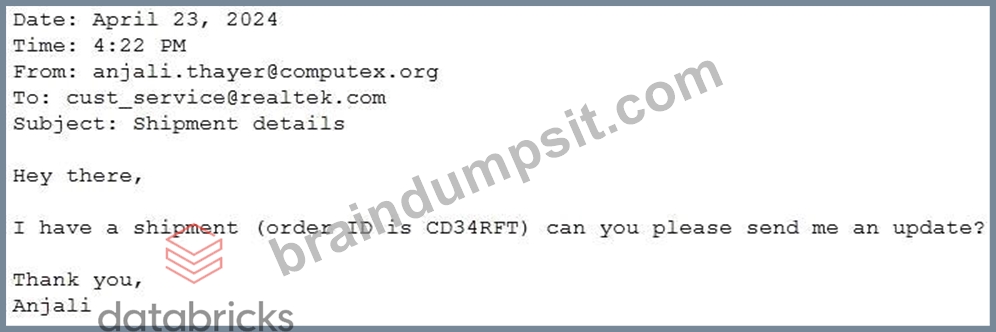
They will need to write a prompt that will extract the relevant information in JSON format with the highest level of output accuracy.
Which prompt will do that?
- A. You will receive customer emails and need to extract date, sender email, and order ID. Return the extracted information in JSON format.
- B. You will receive customer emails and need to extract date, sender email, and order ID. You should return the date, sender email, and order ID information in JSON format.
- C. You will receive customer emails and need to extract date, sender email, and order ID. Return the extracted information in a human-readable format.
- D. You will receive customer emails and need to extract date, sender email, and order ID. Return the extracted information in JSON format.
Here's an example: {"date": "April 16, 2024", "sender_email": "[email protected]", "order_id":
"RE987D"}
Answer: D
Explanation:
Problem Context: The goal is to parse emails to extract certain pieces of information and output this in a structured JSON format. Clarity and specificity in the prompt design will ensure higher accuracy in the LLM' s responses.
Explanation of Options:
* Option A: Provides a general guideline but lacks an example, which helps an LLM understand the exact format expected.
* Option B: Includes a clear instruction and a specific example of the output format. Providing an example is crucial as it helps set the pattern and format in which the information should be structured, leading to more accurate results.
* Option C: Does not specify that the output should be in JSON format, thus not meeting the requirement.
* Option D: While it correctly asks for JSON format, it lacks an example that would guide the LLM on how to structure the JSON correctly.
Therefore,Option Bis optimal as it not only specifies the required format but also illustrates it with an example, enhancing the likelihood of accurate extraction and formatting by the LLM.
NEW QUESTION # 47
A Generative Al Engineer is building a system which will answer questions on latest stock news articles.
Which will NOT help with ensuring the outputs are relevant to financial news?
- A. Increase the compute to improve processing speed of questions to allow greater relevancy analysis C Implement a profanity filter to screen out offensive language
- B. Implement a comprehensive guardrail framework that includes policies for content filters tailored to the finance sector.
- C. Incorporate manual reviews to correct any problematic outputs prior to sending to the users
Answer: A
Explanation:
In the context of ensuring that outputs are relevant to financial news, increasing compute power (option B) does not directly improve the relevance of the LLM-generated outputs. Here's why:
Compute Power and Relevancy:
Increasing compute power can help the model process inputs faster, but it does not inherently improve the relevance of the answers. Relevancy depends on the data sources, the retrieval method, and the filtering mechanisms in place, not on how quickly the model processes the query.
What Actually Helps with Relevance:
Other methods, like content filtering, guardrails, or manual review, can directly impact the relevance of the model's responses by ensuring the model focuses on pertinent financial content. These methods help tailor the LLM's responses to the financial domain and avoid irrelevant or harmful outputs.
Why Other Options Are More Relevant:
A (Comprehensive Guardrail Framework): This will ensure that the model avoids generating content that is irrelevant or inappropriate in the finance sector.
C (Profanity Filter): While not directly related to financial relevancy, ensuring the output is clean and professional is still important in maintaining the quality of responses.
D (Manual Review): Incorporating human oversight to catch and correct issues with the LLM's output ensures the final answers are aligned with financial content expectations.
Thus, increasing compute power does not help with ensuring the outputs are more relevant to financial news, making option B the correct answer.
NEW QUESTION # 48
A Generative AI Engineer is using LangGraph to define multiple tools in a single agentic application. They want to enable the main orchestrator LLM to decide on its own which tools are most appropriate to call for a given prompt. To do this, they must determine the general flow of the code. Which sequence will do this?
- A. 1. Define the tools 2. Load each tool into a separate agent 3. Instruct the LLM to use ReAct to call the appropriate agent
- B. 1. Define the tools inside the agents 2. Load the agents into the LLM 3. Instruct the LLM to use COT reasoning to determine the appropriate agent
- C. 1. Define or import the tools 2. Add tools and LLM to the agent 3. Create the ReAct agent
- D. 1. Define or import the tools 2. Define the agent 3. Initialize the agent with ReAct, the LLM, and the tools
Answer: D
Explanation:
In modern agentic frameworks like LangGraph or LangChain, the standard workflow for creating an autonomous tool-calling agent follows a specific sequence. First, tools must be defined (often as Python functions with clear docstrings, which the LLM uses to understand the tool's purpose). Second, the agent logic is defined, which specifies how the LLM should think. Third, the agent is initialized using a logic pattern like ReAct (Reason + Act). The ReAct framework is essential here because it enables the "orchestrator" loop: the LLM receives a prompt, generates a "Thought" about which tool to use, generates an "Action" to call that tool, receives an "Observation" (the tool's output), and repeats until it can provide a final answer. Loading tools into "separate agents" (C) or defining tools "inside" agents (D) are non-standard patterns that add unnecessary complexity and do not align with the centralized orchestration model required for LangGraph.
NEW QUESTION # 49
A Generative Al Engineer is responsible for developing a chatbot to enable their company's internal HelpDesk Call Center team to more quickly find related tickets and provide resolution. While creating the GenAI application work breakdown tasks for this project, they realize they need to start planning which data sources (either Unity Catalog volume or Delta table) they could choose for this application. They have collected several candidate data sources for consideration:
call_rep_history: a Delta table with primary keys representative_id, call_id. This table is maintained to calculate representatives' call resolution from fields call_duration and call start_time.
transcript Volume: a Unity Catalog Volume of all recordings as a *.wav files, but also a text transcript as *.txt files.
call_cust_history: a Delta table with primary keys customer_id, cal1_id. This table is maintained to calculate how much internal customers use the HelpDesk to make sure that the charge back model is consistent with actual service use.
call_detail: a Delta table that includes a snapshot of all call details updated hourly. It includes root_cause and resolution fields, but those fields may be empty for calls that are still active.
maintenance_schedule - a Delta table that includes a listing of both HelpDesk application outages as well as planned upcoming maintenance downtimes.
They need sources that could add context to best identify ticket root cause and resolution.
Which TWO sources do that? (Choose two.)
- A. transcript Volume
- B. call_detail
- C. call_rep_history
- D. maintenance_schedule
- E. call_cust_history
Answer: A,B
Explanation:
In the context of developing a chatbot for a company's internal HelpDesk Call Center, the key is to select data sources that provide the most contextual and detailed information about the issues being addressed. This includes identifying the root cause and suggesting resolutions. The two most appropriate sources from the list are:
* Call Detail (Option D):
* Contents: This Delta table includes a snapshot of all call details updated hourly, featuring essential fields like root_cause and resolution.
* Relevance: The inclusion of root_cause and resolution fields makes this source particularly valuable, as it directly contains the information necessary to understand and resolve the issues discussed in the calls. Even if some records are incomplete, the data provided is crucial for a chatbot aimed at speeding up resolution identification.
* Transcript Volume (Option E):
* Contents: This Unity Catalog Volume contains recordings in .wav format and text transcripts in .txt files.
* Relevance: The text transcripts of call recordings can provide in-depth context that the chatbot can analyze to understand the nuances of each issue. The chatbot can use natural language processing techniques to extract themes, identify problems, and suggest resolutions based on previous similar interactions documented in the transcripts.
Why Other Options Are Less Suitable:
* A (Call Cust History): While it provides insights into customer interactions with the HelpDesk, it focuses more on the usage metrics rather than the content of the calls or the issues discussed.
* B (Maintenance Schedule): This data is useful for understanding when services may not be available but does not contribute directly to resolving user issues or identifying root causes.
* C (Call Rep History): Though it offers data on call durations and start times, which could help in assessing performance, it lacks direct information on the issues being resolved.
Therefore, Call Detail and Transcript Volume are the most relevant data sources for a chatbot designed to assist with identifying and resolving issues in a HelpDesk Call Center setting, as they provide direct and contextual information related to customer issues.
NEW QUESTION # 50
A Generative Al Engineer at an automotive company would like to build a question-answering chatbot for customers to inquire about their vehicles. They have a database containing various documents of different vehicle makes, their hardware parts, and common maintenance information.
Which of the following components will NOT be useful in building such a chatbot?
- A. Embedding model
- B. Response-generating LLM
- C. Vector database
- D. Invite users to submit long, rather than concise, questions
Answer: D
Explanation:
The task involves building a question-answering chatbot for an automotive company using a database of vehicle-related documents. The chatbot must efficiently process customer inquiries and provide accurate responses. Let's evaluate each component to determine which isnotuseful, per Databricks Generative AI Engineer principles.
* Option A: Response-generating LLM
* An LLM is essential for generating natural language responses to customer queries based on retrieved information. This is a core component of any chatbot.
* Databricks Reference:"The response-generating LLM processes retrieved context to produce coherent answers"("Building LLM Applications with Databricks," 2023).
* Option B: Invite users to submit long, rather than concise, questions
* Encouraging long questions is a user interaction design choice, not a technical component of the chatbot's architecture. Moreover, long, verbose questions can complicate intent detection and retrieval, reducing efficiency and accuracy-counter to best practices for chatbot design. Concise questions are typically preferred for clarity and performance.
* Databricks Reference: While not explicitly stated, Databricks' "Generative AI Cookbook" emphasizes efficient query processing, implying that simpler, focused inputs improve LLM performance. Inviting long questions doesn't align with this.
* Option C: Vector database
* A vector database stores embeddings of the vehicle documents, enabling fast retrieval of relevant information via semantic search. This is critical for a question-answering system with a large document corpus.
* Databricks Reference:"Vector databases enable scalable retrieval of context from large datasets"("Databricks Generative AI Engineer Guide").
* Option D: Embedding model
* An embedding model converts text (documents and queries) into vector representations for similarity search. It's a foundational component for retrieval-augmented generation (RAG) in chatbots.
* Databricks Reference:"Embedding models transform text into vectors, facilitating efficient matching of queries to documents"("Building LLM-Powered Applications").
Conclusion: Option B is not a usefulcomponentin building the chatbot. It's a user-facing suggestion rather than a technical building block, and it could even degrade performance by introducing unnecessary complexity. Options A, C, and D are all integral to a Databricks-aligned chatbot architecture.
NEW QUESTION # 51
A Generative Al Engineer has created a RAG application to look up answers to questions about a series of fantasy novels that are being asked on the author's web forum. The fantasy novel texts are chunked and embedded into a vector store with metadata (page number, chapter number, book title), retrieved with the user's query, and provided to an LLM for response generation. The Generative AI Engineer used their intuition to pick the chunking strategy and associated configurations but now wants to more methodically choose the best values.
Which TWO strategies should the Generative AI Engineer take to optimize their chunking strategy and parameters? (Choose two.)
- A. Add a classifier for user queries that predicts which book will best contain the answer. Use this to filter retrieval.
- B. Choose an appropriate evaluation metric (such as recall or NDCG) and experiment with changes in the chunking strategy, such as splitting chunks by paragraphs or chapters.
Choose the strategy that gives the best performance metric. - C. Create an LLM-as-a-judge metric to evaluate how well previous questions are answered by the most appropriate chunk. Optimize the chunking parameters based upon the values of the metric.
- D. Change embedding models and compare performance.
- E. Pass known questions and best answers to an LLM and instruct the LLM to provide the best token count. Use a summary statistic (mean, median, etc.) of the best token counts to choose chunk size.
Answer: B,C
NEW QUESTION # 52
A team uses Mosaic AI Vector Search to retrieve documents for their Retrieval-Augmented Generation (RAG) pipeline. The search query returns five relevant documents, and the first three are added to the prompt as context. Performance evaluation with Agent Evaluation shows that some lower-ranked retrieved documents have higher context relevancy scores than higher-ranked documents. Which option should the team consider to optimize this workflow?
- A. Modify the prompt to instruct the LLM to order the documents based on the relevance scores.
- B. Use a reranker to order the documents based on the relevance scores.
- C. Use a different embedding model for computing document embeddings.
- D. Increase the number of documents added to the prompt to improve context relevance.
Answer: B
Explanation:
The scenario describes a common "retrieval gap" where the initial bi-encoder (embedding model) used for vector search identifies relevant documents but does not rank them perfectly. This happens because embedding models represent entire documents as a single vector, which can lose nuance. The standard engineering solution is to implement a Reranker (Cross-Encoder). Unlike embedding models, a reranker processes the query and a candidate document simultaneously, allowing it to capture deep semantic interactions between the two. In a Mosaic AI workflow, after the vector search retrieves the top $k$ documents, the reranker evaluates those specific $k$ documents to produce a more accurate relevance score. This ensures that the most contextually relevant documents are placed at the top of the list (and thus the top of the LLM prompt), which is crucial because LLMs are sensitive to document order and often prioritize information found at the beginning of the context.
NEW QUESTION # 53
A Generative AI Engineer at an automotive company would like to build a question-answering chatbot to help customers answer specific questions about their vehicles. They have:
A catalog with hundreds of thousands of cars manufactured since the 1960s Historical searches with user queries and successful matches Descriptions of their own cars in multiple languages They have already selected an open-source LLM and created a test set of user queries. They need to discard techniques that will not help them build the chatbot. Which do they discard?
- A. Adding few-shot examples for response generation
- B. Setting chunk size to match the model's context window to maximize coverage
- C. Fine-tuning an embedding model on automotive terminology
- D. Implementing metadata filtering based on car models and years
Answer: B
Explanation:
According to Generative AI engineering standards for Retrieval-Augmented Generation (RAG), chunking strategy is a critical optimization variable. Setting the chunk size to match the model's maximum context window (e.g., 4k or 8k tokens) is a poor practice and should be discarded. Large chunks introduce significant "noise" into the LLM's context, as only a small portion of a massive chunk usually contains the answer to a specific query. This leads to the "lost in the middle" phenomenon where LLMs struggle to extract relevant information from bloated contexts. Furthermore, large chunks reduce the precision of the vector search. Standard best practices involve using smaller, semantically meaningful chunks (typically 256-512 tokens) with overlap to maintain context. In contrast, metadata filtering (B) is essential for narrowing searches to specific car years, fine-tuning embeddings (C) improves retrieval accuracy for domain-specific technical terms, and few-shot examples (D) guide the LLM's output format and tone.
NEW QUESTION # 54
......
Reliable Study Materials for Databricks-Generative-AI-Engineer-Associate Exam Success For Sure: https://passguide.braindumpsit.com/Databricks-Generative-AI-Engineer-Associate-latest-dumps.html