


ATM Free Exam Study Guide! (Updated 52 Questions)
ATM Dumps for ISTQB Test Manager Certified Exam Questions and Answer
For more info visit:
NEW QUESTION # 22
The main objectives the senior management team wants to achieve are:
- to reduce the costs associated with dynamic testing
- to use reviews to ensure that the project is on course for success and following the plan
- to use reviews as a well-documented and effective bug-removal activity following a formal process with well- defined roles
- to determine the effectiveness of reviews in terms of phase containment
- to improve phase containment effectiveness
Which of the following answers would you expect to describe the best way to achieve these objectives?
- A. You should plan for formal exit-phase reviews at the end of each development phase and testing phase, and plan for a process of gathering information from testing to perform an analysis of the bugs found during testing to determine the people responsible for those bugs
- B. You should plan for lightweight exit-phase reviews at the end of each development and testing phase, and plan for a process of gathering information from testing to perform an analysis aimed at identifying the larger cluster of defects
- C. You should plan for formal exit-phase reviews at the end of each development and testing phase, and plan for a process of gathering information from testing to perform an analysis of the bugs found during testing to determine the phase in which they have been introduced
- D. You should plan for formal exit-phase reviews at the end of each development and testing phase, and plan for a process of gathering information from testing to perform an analysis aimed at identifying the larger cluster of defects
Answer: C
Explanation:
Section: Test Management
Explanation/Reference:
NEW QUESTION # 23
After the presentation, you are asked to explain the chart.
Assume you have applied a full risk-based testing strategy.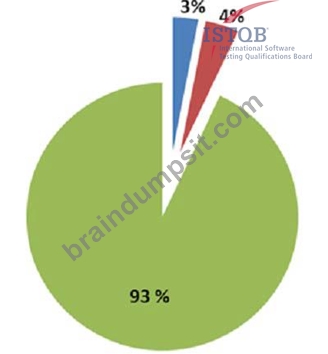
Which of the following answers would you expect to best describe the pie chart?
- A. 97 percent of the risk items has been tested. No open bugs or test failures remain. Only 3 percent of risk items remains to be covered by the remaining test
- B. All the risk items have been covered with tests. No more risk items remain to test
- C. According to the full risk-based testing strategy applied, it is very likely that the highest-risk items, tests and bugs remain in the blue and red areas. Therefore, it is very risky to release the application
- D. Only the lowest-risk items, tests and bugs should remain in the blue and red areas. Therefore the application can be released at any time subject to management of the items identified in those areas
Answer: D
Explanation:
Explanation/Reference:
Explanation:
NEW QUESTION # 24
Which of the following statements describing the consequences of specifying test conditions at a detailed level is NOT true?
- A. The specification of test conditions at a detailed level can require the implementation of an adequate level of formality across the team
- B. For system testing, the specification of test conditions at a detailed level, carried out early in the project as soon as the test basis is established, can contribute to defect prevention
- C. In an environment where the test basis is continuously changing, it is recommended to specify test conditions at a detailed level in order to achieve a better maintainability
- D. The specification of test conditions at a detailed level can be effective when no formal requirements or other development work products are available
Answer: C
Explanation:
Explanation/Reference:
Explanation:
NEW QUESTION # 25
Consider an information system of a Pay-Tv company based on a SOA architecture.
The integrated system currently consists of three core systems:
- a CRM (Customer Relationship Management) system
- a BRM (Billing and Revenue Management) system
- a CAS (Conditional Access System) system all of them communicating with SOA
Middleware.
You have been asked to manage the testing activities for the integration of two additional
off-the-shelf systems from two different vendors: a SMS (Short Message Service) server
and an IVR (Interactive Voice Response) system.
Assume that there is a high likelihood that the two off-the-shelf systems will be low-quality
and that you have a clear proof that the testing performed by the two vendors on their
systems has been unsystematic and unprofessional. This obviously leads to higher quality
risk for the overall integrated system.
You are the Test Manager of this project. Your main goal is to plan for testing activities to
mitigate this risk.
Which of the following answers best describes the test activities (assuming it is possible to
perform all of them) you should plan for?
K4 3 credits
- A. You should directly plan for a single end-to-end test focused on end-to-end tests of the
overall integrated system without an acceptance test of the two off-the-shelf systems - B. You should plan for adequate re-testing of both the systems followed by a system
integration test and an end-to-end test of the overall integrated system - C. You should plan for two levels: a system integration test and an end-to-end test of the
overall integrated system - D. You should plan for an informal and minimal acceptance test of the two off-the-shelf
systems and then a single end-to-end test of the overall integrated system
Answer: B
NEW QUESTION # 26
Which of the following statements describing how identified product quality risks should be
mitigated and managed, is true?
K2 1 credit
- A. The extent of re-testing and regression testing activities should be based on the risk
level - B. Risk mitigation of product quality risks can be effective only after starting test execution
- C. The priority of the development and execution of tests should not be based on the risk
level but only on the likelihood - D. The identification of new risks, the re-assessment of the level of existing risks and the
evaluation of the effectiveness of risk mitigation activities should only occur at the very
beginning of a project
Answer: A
NEW QUESTION # 27
For which of the following activities would the costs be classified as a cost of detection?
K2 1 credit
- A. Writing test specifications according to the test design
- B. Training developers to better understand the new features of the coding language they
will use on the project - C. Re-running a test case, during the system testing phase, to verify that a fix eliminates a
previously found defect - D. Fixing field failures
Answer: A
NEW QUESTION # 28
The following chart plots the cumulative number of defects opened against the cumulative
number of defects closed during system testing of a software product.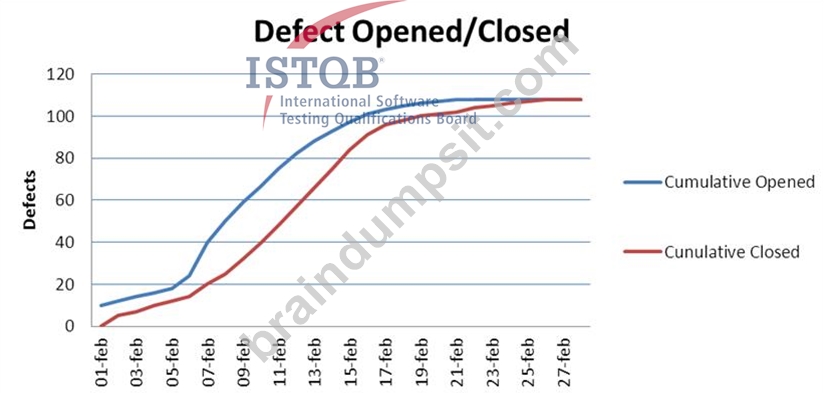
Which of the following statements is true?
K2 1 credit
- A. The chart seems to indicate that the defect management process is working well
- B. The chart indicates that you have plenty of problems left to find
- C. The chart can be used to reveal test progress problems
- D. The chart seems to indicate that the defect management process is not working well
Answer: A
NEW QUESTION # 29
In your organization the following tools of the same vendor are currently in use a requirements management tool, a test management tool and a bug tracking tool.
You are the Test Manager.
You are currently evaluating a test automation tool of the same vendor (to complete the vendor's tool suite) against an interesting open-source test automation tool under the GNU GPL (General Public License).
There are no initial costs associated to that open-source tool.
Which of the following statements associated to the selection of the open-source tool is correct in this scenario?
- A. There are no initial costs for the open-source tool but you should carefully consider the costs associated to the integration with the existing tools and also evaluate the recurring costs
- B. The open-source tool can be modified but only if the community of developers of that tool gives you the formal permission to modify it
- C. There are no initial costs for the open-source tool because open-source tools are usually low-quality, while vendor tools have always a better quality than the corresponding open-source tools
- D. The open-source tool can be modified but it can't be distributed further in any way
Answer: A
Explanation:
Section: Test Tools and Automation
Explanation/Reference:
NEW QUESTION # 30
Which of the following statements about the TMMi test process improvement model is true?
K2 1 credit
- A. TMMi has a staged architecture for process improvement with seven maturity levels
- B. At TMMi level 1 testing is chaotic without a defined process, and it is often seen as the
same as debugging - C. TMMi provides an approach for test process improvement such as the IDEAL (Initiating,
Diagnosing, Establishing, Acting and Learning) model - D. In TMMi all the process areas at lower levels must be 75% complete by achieving
specific and generic goals in order to claim the higher level
Answer: B
NEW QUESTION # 31
Which test process improvement model consists of five maturity levels?
- A. CMMi
- B. TMMi
- C. TPI NEXT
- D. GQM
Answer: B
Explanation:
* Test Process Improvement Models:
* TMMi (Test Maturity Model Integration)has five maturity levels: Initial, Managed, Defined, Measured, and Optimization.
* Other models, likeTPI NEXT, focus on key areas but do not use a maturity-level framework.
* CMMi (Capability Maturity Model Integration)applies broadly to process improvement but is not specific to testing.
* GQM (Goal-Question-Metric)is a measurement approach, not a maturity model.
* Evaluation of Options:
* A (TMMi)is correct as it directly incorporates a five-level maturity framework for test process improvement.
* Other options are not aligned with the question context.
References and Syllabus Alignment:
* TMMi is referenced in the ISTQB syllabus under "Improving the Test Process" (TM-1.5.1) as a standard for maturity models.
NEW QUESTION # 32
Consider the following skills assessment spreadsheet for your test team (consisting of four
team members):
This spreadsheet has three sections: technical expertise, testing skills and professionalism.
The skill levels for each skill area for both the "technical expertise" and "testing skills"
sections have been rated on a four-point scale:
- E (Expert): indicates that a person has expert knowledge and experience in the skill area
- B (Beginner): indicates that a person has some knowledge and experience in the skill
area but he/she is not autonomous
- W (Wants to learn): indicates that a person has no knowledge or experience in the skill
area but he/she wants to learn that skill
- NI (Not Interested): indicates that a person has no knowledge or experience in the skill
area and he/she is not interested to learn that skill
The skill levels for each skill area of the "professionalism" section have been rated on a
three point scale (H=High, M=Medium, L=Low).
You are using this skills assessment spreadsheet in order to define a training development
plan for your test team.
Your objective is to fill the skill gaps by having at least a team member rated as an expert
for each skill identified for the "technical expertise" and "testing skills" sections, and with the
ability to train the other team members.
Considering the budget constraints you can send only one person to a training course.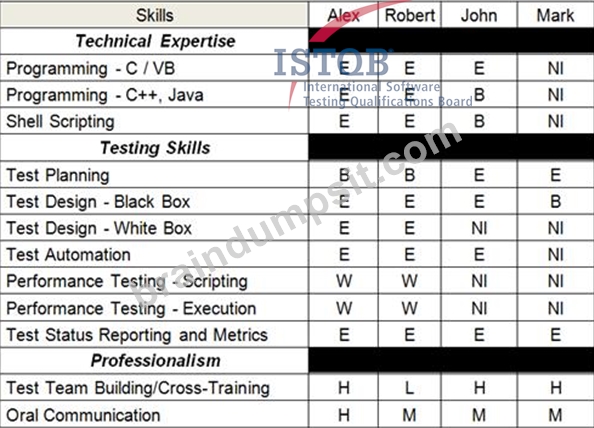
Based only on the given information, which of the following answers would you expect to
be the best option to achieve your objective?
K4 3 credits
- A. Send Robert to a performance testing training course
- B. Send John to a performance testing training course
- C. Send Alex to a performance testing training course
- D. Send Mark to a test automation training course
Answer: C
NEW QUESTION # 33
You are the Test Manager of a new project that will have three formal levels of testinG.
unit, integration and system testing. The testing strategy you decide to adopt a blend of
risk-based testing and reactive testing strategies.
Which of the following answers describes the most consistent example of implementation
of this test strategy during the execution of the system tests?
K2 1 credit
- A. Your test team executes scripted tests designed and implemented before the execution
of the system test phase, to cover the identified product risks. It also performs exploratory
testing sessions throughout the system test phase - B. Your test team autonomously performs some exploratory testing sessions and, at the
very end of the system testing phase, it also executes more system tests under the
guidance of a sample of users - C. Your test team executes system tests under the guidance of a sample of users
throughout the system test phase - D. Your test team executes exploratory tests following a session-based test management
approach throughout the system test phase
Answer: A
NEW QUESTION # 34
Your test team consists of four members (Mary, Bob, Mark, Dave) with different interpersonal skills.
The following skills assessment spreadsheet shows the characteristics of the team members with respect to a list of interpersonal-skills (for each characteristic only the member with the highest level of that characteristic is indicated and marked with 'X'):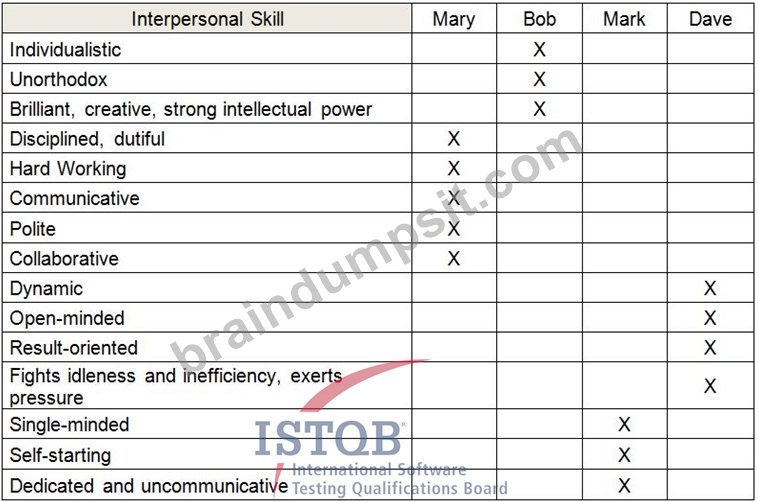
On the next project a member of your test team will have to perform some routine tasks requiring collaboration with other teams.
Who in your test team would you expect to be most suitable at doing these tasks?
- A. Dave
- B. Bob
- C. Mark
- D. Mary
Answer: D
Explanation:
Explanation/Reference:
Explanation:
NEW QUESTION # 35
Which of the following is required to apply an experience-based testing approach''
- A. A full risk-assessment to support risk prioritization
- B. Tester knowledge of the system and its usage
- C. Detailed requirements
- D. Usage models
Answer: B
Explanation:
* Experience-Based Testing:
* This testing approach relies on the testers' knowledge, experience, and intuition about the system and its usage rather than formal requirements or models.
* It is often used when documentation is incomplete or time constraints limit more structured approaches.
* Evaluation of Options:
* A(Detailed requirements) andB(Usage models) are associated with structured testing techniques.
* Cis correct as experience-based testing depends on the testers' understanding of the system.
* D(Full risk assessment) supports risk-based testing, not experience-based testing.
References and Syllabus Alignment:
* Experience-based testing is detailed under "Test Techniques" (TM-1.4.1) in the ISTQB syllabus.
NEW QUESTION # 36
Which of the following is an example of the test closure activity indicated as "lessons learned"?
- A. Deliver an automated regression test suite, used during the system test phase of a software product released into production, to the team responsible for maintenance testing
- B. Deliver a list of the open defects of a software product released into production to the service desk team
- C. Archive all the test results of the acceptance testing phase
- D. Participate in a meeting at the end of a project aimed at better managing the events and problems of future projects
Answer: D
Explanation:
Section: Testing Process
Explanation/Reference:
NEW QUESTION # 37
You are the Test Manager on a project following an iterative life-cycle model. The project should consist of nine iterations of one month duration each. It is planned to develop the most important features to have a stable core of the application in the first three iterations and to add the additional features in the last six iterations.
At the beginning of the first iteration, only a draft version of the requirements specification document for the core features is available. Assume that during each of the first three iterations, the chosen features are fully completed and unit tested.
Which of the following statements is true in this context?
- A. You should apply the same test strategy as used in a sequential life cycle model
- B. The system test phase should start when all the requirements are frozen
- C. You should allocate a large effort for system testing during the first three iterations
- D. You should allocate all the effort for the system test phase only in the last iteration
Answer: C
Explanation:
Section: Test Management
Explanation/Reference:
NEW QUESTION # 38
Which of the following statements about the TMMi test process improvement model is true?
K2 1 credit
- A. TMMi provides an approach for test process improvement such as the IDEAL (Initiating, Diagnosing, Establishing, Acting and Learning) model
- B. At TMMi level 1 testing is chaotic without a defined process, and it is often seen as the same as debugging
- C. TMMi has a staged architecture for process improvement with seven maturity levels
- D. In TMMi all the process areas at lower levels must be 75% complete by achieving specific and generic goals in order to claim the higher level
Answer: B
Explanation:
Explanation/Reference:
Explanation:
NEW QUESTION # 39
Your team has been assigned to a new project You have a mix of manual testers and automation engineers but everyone is currently doing manual testing.The development learn has already decided to use DevOps as its approach but they have never used it before and are happy to take your input Unfortunately, about 50% of the development is completed already In the testing your team is doing they are finding that about 40% of the defects they catch are actually regressions caused by other changes Given this information what should you do to help mitigate risk'?
- A. Review the policies regarding defect reporting and ensure your team is adding all the necessary information to each defect report
- B. Optimize the test environment to provide faster testing with more accurate test data and better testing tools to provide wider coverage
- C. Implement code reviews for the development team and require tester signoff before code can be released into the pipeline
- D. Pivot part of the team from manual testing to test automation development to address the regression risk and implement better quality gates to reduce regressions
Answer: D
Explanation:
* Identifying the Risk:
* High regression rates (40%) indicate a need to improve regression testing capabilities and reduce risks.
* Test automation addresses regressions effectively by enabling faster and repeated testing.
* Evaluation of Options:
* Ais irrelevant to the regression risks highlighted.
* Bis correct because it emphasizes test automation for regressions and quality gates to prevent defect leaks.
* Cis partially valid but does not directly address regression issues.
* Dfocuses on development practices, which, while helpful, does not directly reduce regression risks.
References and Syllabus Alignment:
* This aligns with ISTQB guidelines on balancing manual and automated testing in regression scenarios (TM-1.6.3, TM-1.4.2).
NEW QUESTION # 40
......
ISTQB Certified Tester Advanced Level - Test Manager [Syllabus 2012] certification exam is a globally recognized certification for those who aspire to become proficient in the field of software testing. Advanced Test Management Exam v3.0 - ISTQB certification is designed to validate the advanced level of knowledge and skills required to manage and lead testing teams effectively. Advanced Test Management Exam v3.0 - ISTQB certification exam focuses on various aspects of software testing, including testing processes, test planning, test estimation, test monitoring, test control, and test reporting. Advanced Test Management Exam v3.0 - ISTQB certification exam also covers risk-based testing, defect management, and test automation, among others.
Use Real ATM Dumps - 100% Free ATM Exam Dumps: https://passguide.braindumpsit.com/ATM-latest-dumps.html