


DP-201 PDF Dumps Real 2021 Recently Updated Questions
Released Microsoft DP-201 Updated Questions PDF
Topic 2. Designing Data Processing Solutions (25-30%)
- Designing real-time processing solutions: the subtheme requires that the test takers have skills in designing for real-time processing with the help of Azure Databricks & Stream Analytics as well as designing and provisioning compute resources.
- Designing batch processing solutions: here the examinees must show proficiency in designing batch processing solutions that utilize Data Factory and Azure Databricks; defining the optimal data ingestion technique for a batch processing solution; defining where processing is to take place, including at the destination, in transit, or at the source.
NEW QUESTION 18
You have a MongoDB database that you plan to migrate to an Azure Cosmos DB account that uses the MongoDB API.
During testing, you discover that the migration takes longer than expected.
You need to recommend a solution that will reduce the amount of time it takes to migrate the data.
What are two possible recommendations to achieve this goal? Each correct answer presents a complete solution.
NOTE: Each correct selection is worth one point.
- A. Increase the Request Units (RUs).
- B. Add a write region.
- C. Create unique indexes.
- D. Turn off indexing.
- E. Create compound indexes.
Answer: A,D
Explanation:
A: Increase the throughput during the migration by increasing the Request Units (RUs).
For customers that are migrating many collections within a database, it is strongly recommend to configure database-level throughput. You must make this choice when you create the database. The minimum database-level throughput capacity is 400 RU/sec. Each collection sharing database-level throughput requires at least 100 RU/sec.
B: By default, Azure Cosmos DB indexes all your data fields upon ingestion. You can modify the indexing policy in Azure Cosmos DB at any time. In fact, it is often recommended to turn off indexing when migrating data, and then turn it back on when the data is already in Cosmos DB.
References:
https://docs.microsoft.com/bs-latn-ba/Azure/cosmos-db/mongodb-pre-migration
NEW QUESTION 19
You are planning a design pattern based on the Lambda architecture as shown in the exhibit.
Which Azure services should you use f2 or the cold path? To answer, drag the appropriate services to the correct layers. Each service may be used once, more than once, or not at all. You may need to drag the split bar between panes or scroll to view content.
NOTE: Each correct selection is worth one point.
Answer:
Explanation:
Explanation
Layer 2: Azure Data Lake Storage Gen2
Layer 3: Azure SQL Data Warehouse
Azure SQL Data Warehouse can be used for batch processing.
Note: Lambda architectures use batch-processing, stream-processing, and a serving layer to minimize the latency involved in querying big data.
References:
https://azure.microsoft.com/en-us/blog/lambda-architecture-using-azure-cosmosdb-faster-performance-low-tco-l
https://docs.microsoft.com/en-us/azure/architecture/data-guide/technology-choices/batch-processing
NEW QUESTION 20
You need to recommend a solution for storing customer data. What should you recommend?
- A. Azure SQL Data Warehouse
- B. Azure Databricks
- C. Azure Stream Analytics
- D. Azure SQL Database
Answer: B
Explanation:
Explanation
From the scenario:
Customer data must be analyzed using managed Spark clusters.
All cloud data must be encrypted at rest and in transit. The solution must support: parallel processing of customer data.
References:
https://www.microsoft.com/developerblog/2019/01/18/running-parallel-apache-spark-notebook-workloads-on-az
Topic 1, Case study 1The company identifies the following business
requirements:
* External vendors must be able to perform custom analysis of data using machine learning technologies.
* You must display a dashboard on the operations status page that displays the following metrics: telemetry, volume, and processing latency.
* Traffic data must be made available to the Government Planning Department for the purpose of modeling changes to the highway system. The traffic data will be used in conjunction with other data such as information about events such as sporting events, weather conditions, and population statistics. External data used during the modeling is stored in on-premises SQL Server 2016 databases and CSV files stored in an Azure Data Lake Storage Gen2 storage account.
* Information about vehicles that have been detected as going over the speed limit during the last 30 minutes must be available to law enforcement officers. Several law enforcement organizations may respond to speeding vehicles.
* The solution must allow for searches of vehicle images by license plate to support law enforcement investigations. Searches must be able to be performed using a query language and must support fuzzy searches to compensate for license plate detection errors.
Telemetry Capture
The telemetry capture system records each time a vehicle passes in front of a sensor. The sensors run on a custom embedded operating system and record the following telemetry data:
* Time
* Location in latitude and longitude
* Speed in kilometers per hour (kmph)
* Length of vehicle in meters
Visual Monitoring
The visual monitoring system is a network of approximately 1,000 cameras placed near highways that capture images of vehicle traffic every 2 seconds. The cameras record high resolution images. Each image is approximately 3 MB in size.
This is a case study. Case studies are not timed separately. You can use as much exam time as you would like to complete each case. However, there may be additional case studies and sections on this exam. You must manage your time to ensure that you are able to complete all questions included on this exam in the time provided.
To answer the questions included in a case study, you will need to reference information that is provided in the case study. Case studies might contain exhibits and other resources that provide more information about the scenario that is described in the case study. Each question is independent of the other question on this case study.
At the end of this case study, a review screen will appear. This screen allows you to review your answers and to make changes before you move to the next sections of the exam. After you begin a new section, you cannot return to this section.
To start the case study
To display the first question on this case study, click the Next button. Use the buttons in the left pane to explore the content of the case study before you answer the questions. Clicking these buttons displays information such as business requirements, existing environment, and problem statements. If the case study has an All Information tab, note that the information displayed is identical to the information displayed on the subsequent tabs. When you are ready to answer a question, click the button to return to the question.
Requirements
Business
The company identifies the following business requirements:
* You must transfer all images and customer data to cloud storage and remove on-premises servers.
* You must develop an analytical processing solution for transforming customer data.
* You must develop an image object and color tagging solution.
* Capital expenditures must be minimized.
* Cloud resource costs must be minimized.
Technical
The solution has the following technical requirements:
* Tagging data must be uploaded to the cloud from the New York office location.
* Tagging data must be replicated to regions that are geographically close to company office locations.
* Image data must be stored in a single data store at minimum cost.
* Customer data must be analyzed using managed Spark clusters.
* Power BI must be used to visualize transformed customer data.
* All data must be backed up in case disaster recovery is required.
Security and optimization
All cloud data must be encrypted at rest and in transit. The solution must support:
* parallel processing of customer data
* hyper-scale storage of images
* global region data replication of processed image data
NEW QUESTION 21
You need to recommend a security solution to grant anonymous users permission to access the blobs in a specific container only.
What should you include in the recommendation?
- A. Role assignments
- B. access keys for the storage account
- C. the public access level for the blobs service
- D. shared access signatures (SAS)
Answer: C
Explanation:
Explanation/Reference:
Explanation:
You can enable anonymous, public read access to a container and its blobs in Azure Blob storage. By doing so, you can grant read-only access to these resources without sharing your account key, and without requiring a shared access signature (SAS).
Public read access is best for scenarios where you want certain blobs to always be available for anonymous read access.
Reference:
https://docs.microsoft.com/en-us/azure/storage/blobs/storage-manage-access-to-resources
NEW QUESTION 22
You are designing a recovery strategy for your Azure SQL Databases.
The recovery strategy must use default automated backup settings. The solution must include a Point-in time restore recovery strategy.
You need to recommend which backups to use and the order in which to restore backups.
What should you recommend? To answer, select the appropriate configuration in the answer area.
NOTE: Each correct selection is worth one point.
Answer:
Explanation:
Explanation
All Basic, Standard, and Premium databases are protected by automatic backups. Full backups are taken every week, differential backups every day, and log backups every 5 minutes.
References:
https://azure.microsoft.com/sv-se/blog/azure-sql-database-point-in-time-restore/
NEW QUESTION 23
You need to design the solution for analyzing customer data.
What should you recommend?
- A. Azure Cognitive Services
- B. Azure SQL Data Warehouse
- C. Azure Data Lake Storage
- D. Azure Batch
- E. Azure Databricks
Answer: E
Explanation:
Customer data must be analyzed using managed Spark clusters.
You create spark clusters through Azure Databricks.
Reference:
https://docs.microsoft.com/en-us/azure/azure-databricks/quickstart-create-databricks-workspace-portal
NEW QUESTION 24
You are planning the deployment of two separate Azure Cosmos DB databases named db1 and db2.
You need to recommend a deployment strategy that meets the following requirements:
* Costs for both databases must be minimized.
* Db1 must meet an SLA of 99.99% for both reads and writes.
* Db2 must meet an SLA of 99.99% for writes and 99.999% for reads.
Which deployment strategy should you recommend for each database? To answer, select the appropriate options in the answer area.
NOTE: Each correct selection is worth one point.
Answer:
Explanation:
Explanation
Db1: A single read/write region
Db2: A single write region and multi read regions
References:
https://docs.microsoft.com/en-us/azure/cosmos-db/high-availability
NEW QUESTION 25
You manage an on-premises server named Server1 that has a database named Database1. The company purchases a new application that can access data from Azure SQL Database.
You recommend a solution to migrate Database1 to an Azure SQL Database instance.
What should you recommend? To answer, select the appropriate configuration in the answer area.
NOTE: Each correct selection is worth one point.
Answer:
Explanation:
Explanation
References:
https://docs.microsoft.com/en-us/azure/sql-database/sql-database-import
NEW QUESTION 26
Note: This question is part of a series of questions that present the same scenario. Each question in the series contains a unique solution that might meet the stated goals. Some question sets might have more than one correct solution, while others might not have a correct solution.
After you answer a question in this section, you will NOT be able to return to it. As a result, these questions will not appear in the review screen.
A company is developing a solution to manage inventory data for a group of automotive repair shops. The solution will use Azure SQL Data Warehouse as the data store.
Shops will upload data every 10 days.
Data corruption checks must run each time data is uploaded. If corruption is detected, the corrupted data must be removed.
You need to ensure that upload processes and data corruption checks do not impact reporting and analytics processes that use the data warehouse.
Proposed solution: Insert data from shops and perform the data corruption check in a transaction. Rollback transfer if corruption is detected.
Does the solution meet the goal?
- A. Yes
- B. No
Answer: B
Explanation:
Instead, create a user-defined restore point before data is uploaded. Delete the restore point after data corruption checks complete.
References:
https://docs.microsoft.com/en-us/azure/sql-data-warehouse/backup-and-restore
NEW QUESTION 27
You need to design the solution for analyzing customer data.
What should you recommend?
- A. Azure Cognitive Services
- B. Azure SQL Data Warehouse
- C. Azure Data Lake Storage
- D. Azure Batch
- E. Azure Databricks
Answer: E
Explanation:
Customer data must be analyzed using managed Spark clusters.
You create spark clusters through Azure Databricks.
References:
https://docs.microsoft.com/en-us/azure/azure-databricks/quickstart-create-databricks-workspace-portal
Topic 3, Case study
Case study
This is a case study. Case studies are not timed separately. You can use as much exam time as you would like to complete each case. However, there may be additional case studies and sections on this exam. You must manage your time to ensure that you are able to complete all questions included on this exam in the time provided.
To answer the questions included in a case study, you will need to reference information that is provided in the case study. Case studies might contain exhibits and other resources that provide more information about the scenario that is described in the case study. Each question is independent of the other question on this case study.
At the end of this case study, a review screen will appear. This screen allows you to review your answers and to make changes before you move to the next sections of the exam. After you begin a new section, you cannot return to this section.
To start the case study
To display the first question on this case study, click the Next button. Use the buttons in the left pane to explore the content of the case study before you answer the questions. Clicking these buttons displays information such as business requirements, existing environment, and problem statements. If the case study has an All Information tab, note that the information displayed is identical to the information displayed on the subsequent tabs. When you are ready to answer a question, click the Question button to return to the question.
Background
Current environment
The company has the following virtual machines (VMs):
Requirements
Storage and processing
You must be able to use a file system view of data stored in a blob.
You must build an architecture that will allow Contoso to use the DB FS filesystem layer over a blob store. The architecture will need to support data files, libraries, and images. Additionally, it must provide a web-based interface to documents that contain runnable command, visualizations, and narrative text such as a notebook.
CONT_SQL3 requires an initial scale of 35000 IOPS.
CONT_SQL1 and CONT_SQL2 must use the vCore model and should include replicas. The solution must support 8000 IOPS.
The storage should be configured to optimized storage for database OLTP workloads.
Migration
* You must be able to independently scale compute and storage resources.
* You must migrate all SQL Server workloads to Azure. You must identify related machines in the on-premises environment, get disk size data usage information.
* Data from SQL Server must include zone redundant storage.
* You need to ensure that app components can reside on-premises while interacting with components that run in the Azure public cloud.
* SAP data must remain on-premises.
* The Azure Site Recovery (ASR) results should contain per-machine data.
Business Requirements
* You must design a regional disaster recovery topology.
* The database backups have regulatory purposes and must be retained for seven years.
* CONT_SQL1 stores customers sales data that requires ETL operations for data analysis. A solution is required that reads data from SQL, performs ETL, and outputs to Power BI. The solution should use managed clusters to minimize costs. To optimize logistics, Contoso needs to analyze customer sales data to see if certain products are tied to specific times in the year.
* The analytics solution for customer sales data must be available during a regional outage.
Security and auditing
* Contoso requires all corporate computers to enable Windows Firewall.
* Azure servers should be able to ping other Contoso Azure servers.
* Employee PII must be encrypted in memory, in motion, and at rest. Any data encrypted by SQL Server must support equality searches, grouping, indexing, and joining on the encrypted data.
* Keys must be secured by using hardware security modules (HSMs).
* CONT_SQL3 must not communicate over the default ports
Cost
* All solutions must minimize cost and resources.
* The organization does not want any unexpected charges.
* The data engineers must set the SQL Data Warehouse compute resources to consume 300 DWUs.
* CONT_SQL2 is not fully utilized during non-peak hours. You must minimize resource costs for during non-peak hours.
NEW QUESTION 28
You need to design the system for notifying law enforcement officers about speeding vehicles.
How should you design the pipeline? To answer, drag the appropriate services to the correct locations. Each service may be used once, more than once, or not at all. You may need to drag the split bar between panes or scroll to view content.
NOTE: Each correct selection is worth one point.
Answer:
Explanation:
Explanation

Scenario:
Information about vehicles that have been detected as going over the speed limit during the last 30 minutes must be available to law enforcement officers. Several law enforcement organizations may respond to speeding vehicles.
Telemetry Capture
The telemetry capture system records each time a vehicle passes in front of a sensor. The sensors run on a custom embedded operating system and record the following telemetry data:
* Time
* Location in latitude and longitude
* Speed in kilometers per hour (kmph)
* Length of vehicle in meters
Reference:
https://docs.microsoft.com/en-us/azure/azure-databricks/what-is-azure-databricks
NEW QUESTION 29
A company purchases IoT devices to monitor manufacturing machinery. The company uses an IoT appliance to communicate with the IoT devices.
The company must be able to monitor the devices in real-time.
You need to design the solution.
What should you recommend?
- A. Azure Data Factory instance using Azure PowerShell
- B. Azure Stream Analytics cloud job using Azure PowerShell
- C. Azure Data Factory instance using Microsoft Visual Studio
- D. Azure Analysis Services using Microsoft Visual Studio
Answer: B
Explanation:
Stream Analytics is a cost-effective event processing engine that helps uncover real-time insights from devices, sensors, infrastructure, applications and data quickly and easily.
Monitor and manage Stream Analytics resources with Azure PowerShell cmdlets and powershell scripting that execute basic Stream Analytics tasks.
Note: Visual Studio 2019 and Visual Studio 2017 also support Stream Analytics Tools.
Reference:
https://cloudblogs.microsoft.com/sqlserver/2014/10/29/microsoft-adds-iot-streaming-analytics-data-production- and-workflow-services-to-azure/
NEW QUESTION 30
You are designing security for administrative access to Azure Synapse Analytics.
You need to recommend a solution to ensure that administrators use two-factor authentication when accessing the data warehouse from Microsoft SQL Server Management Studio (SSMS).
What should you include in the recommendation?
- A. Azure Active Directory (Azure AD) Privileged Identity Management (PIM)
- B. Azure conditional access policies
- C. Azure Active Directory (Azure AD) Identity Protection
- D. Azure Key Vault secrets
Answer: B
Explanation:
Explanation/Reference:
https://docs.microsoft.com/en-us/azure/sql-database/sql-database-conditional-access
NEW QUESTION 31
Note: This question is part of a series of questions that present the same scenario. Each question in the series contains a unique solution that might meet the stated goals. Some question sets might have more than one correct solution, while others might not have a correct solution.
After you answer a question in this section, you will NOT be able to return to it. As a result, these questions will not appear in the review screen.
You plan to store delimited text files in an Azure Data Lake Storage account that will be organized into department folders.
You need to configure data access so that users see only the files in their respective department folder.
Solution: From the storage account, you disable a hierarchical namespace, and you use RBAC.
Does this meet the goal?
- A. Yes
- B. No
Answer: B
Explanation:
Explanation
Instead of RBAC use access control lists (ACLs).
Note: Azure Data Lake Storage implements an access control model that derives from HDFS, which in turn derives from the POSIX access control model.
Blob container ACLs does not support the hierarchical namespace, so it must be disabled.
References:
https://docs.microsoft.com/en-us/azure/storage/blobs/data-lake-storage-known-issues
https://docs.microsoft.com/en-us/azure/data-lake-store/data-lake-store-access-control
NEW QUESTION 32
You are designing an Azure Cosmos DB database that will contain news articles.
The articles will have the following properties: Category, Created Datetime, Publish Datetime, Author, Headline, Body Text, and Publish Status. Multiple articles will be published in each category daily, but no two stories in a category will be published simultaneously.
Headlines may be updated over time. Publish Status will have the following values: draft, published, updated, and removed. Most articles will remain in the published or updated status. Publish Datetime will be populated only when Publish Status is set to published.
You will serve the latest articles to websites for users to consume.
You need to recommend a partition key for the database container. The solution must ensure that the articles are served to the websites as quickly as possible.
Which partition key should you recommend?
- A. Category + Created Datetime
- B. Publish Date + random suffix
- C. Publish Status
- D. Headline
Answer: A
Explanation:
Explanation
You can form a partition key by concatenating multiple property values into a single artificial partitionKey property. These keys are referred to as synthetic keys.
Reference:
https://docs.microsoft.com/en-us/azure/cosmos-db/synthetic-partition-keys
NEW QUESTION 33
You have an on-premises MySQL database that is 800 GB in size.
You need to migrate a MySQL database to Azure Database for MySQL. You must minimize service interruption to live sites or applications that use the database.
What should you recommend?
- A. Import and export
- B. Azure Database Migration Service
- C. Dump and restore
- D. MySQL Workbench
Answer: B
Explanation:
You can perform MySQL migrations to Azure Database for MySQL with minimal downtime by using the newly introduced continuous sync capability for the Azure Database Migration Service (DMS). This functionality limits the amount of downtime that is incurred by the application.
References:
https://docs.microsoft.com/en-us/azure/mysql/howto-migrate-online
NEW QUESTION 34
You are planning a design pattern based on the Lambda architecture as shown in the exhibit.
Which Azure service should you use for the hot path?
- A. Azure Data Catalog
- B. Azure SQL Database
- C. Azure Synapse Analytics
- D. Azure Cosmos DB
Answer: D
Explanation:
Explanation
In Azure, all of the following data stores will meet the core requirements supporting real-time processing:
* Apache Spark in Azure Databricks
* Azure Stream Analytics
* HDInsight with Spark Streaming
* HDInsight with Storm
* Azure Functions
* Azure App Service WebJobs
Note: Lambda architectures use batch-processing, stream-processing, and a serving layer to minimize the latency involved in querying big data.
Reference:
https://azure.microsoft.com/en-us/blog/lambda-architecture-using-azure-cosmosdb-faster-performance-low-tco-l
https://docs.microsoft.com/en-us/azure/architecture/data-guide/technology-choices/stream-processing
https://docs.microsoft.com/en-us/azure/cosmos-db/lambda-architecture
NEW QUESTION 35
You design data engineering solutions for a company.
You must integrate on-premises SQL Server data into an Azure solution that performs Extract-Transform-Load (ETL) operations have the following requirements:
* Develop a pipeline that can integrate data and run notebooks.
* Develop notebooks to transform the data.
* Load the data into a massively parallel processing database for later analysis.
You need to recommend a solution.
What should you recommend? To answer, select the appropriate options in the answer area.
NOTE: Each correct selection is worth one point.
Answer:
Explanation:
Explanation

NEW QUESTION 36
A company stores large datasets in Azure, including sales transactions and customer account information.
You must design a solution to analyze the dat
a. You plan to create the following HDInsight clusters:
You need to ensure that the clusters support the query requirements.
Which cluster types should you recommend? To answer, select the appropriate configuration in the answer area.
NOTE: Each correct selection is worth one point.
Answer:
Explanation:
References:
https://docs.microsoft.com/bs-latn-ba/azure/hdinsight/hdinsight-hadoop-optimize-hive-query?toc=%2Fko-kr%2Fazure%2Fhdinsight%2Finteractive-query%2FTOC.json&bc=%2Fbs-latn-ba%2Fazure%2Fbread%2Ftoc.json
NEW QUESTION 37
You need to design a data architecture to bring together all your data at any scale and provide insights into all your users through the use of analytical dashboards, operational reports, and advanced analytics.
How should you complete the architecture? To answer, drag the appropriate Azure services to the correct locations in the architecture. Each service may be used once, more than once, or not at all. You may need to drag the split bar between panes or scroll to view content.
NOTE: Each correct selection is worth one point.
Answer:
Explanation:
Explanation
Ingest: Azure Data Factory
Store: Azure Blob storage
Model & Serve: Azure SQL Data Warehouse
Load data into Azure SQL Data Warehouse.
Prep & Train: Azure Databricks.
Extract data from Azure Blob storage.
References:
https://docs.microsoft.com/en-us/azure/azure-databricks/databricks-extract-load-sql-data-warehouse
NEW QUESTION 38
You have data on the 75,000 employees of your company. The data contains the properties shown in the following table.
You need to store the employee data in an Azure Cosmos DB container. Most queries on the data will filter by the Current Department and the Employee Surname properties.
Which partition key and item ID should you use for the container? To answer, select the appropriate options in the answer area.
NOTE: Each correct selection is worth one point.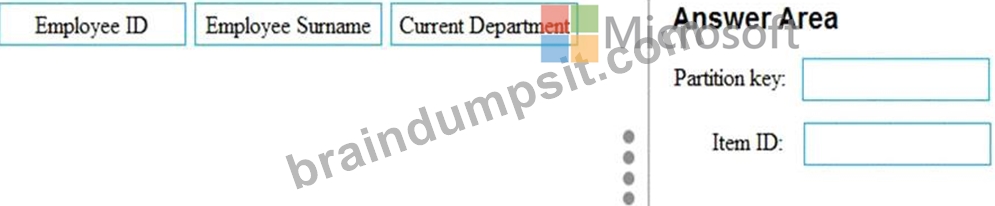
Answer:
Explanation:
Explanation
Partition key: Current Department
Item ID: Employee ID
References:
https://docs.microsoft.com/en-us/rest/api/storageservices/designing-a-scalable-partitioning-strategy-for-azure-tab
NEW QUESTION 39
You need to design the encryption strategy for the tagging data and customer data.
What should you recommend? To answer, drag the appropriate setting to the correct drop targets. Each source may be used once, more than once, or not at all. You may need to drag the split bar between panes or scroll to view content.
NOTE: Each correct selection is worth one point.
Answer:
Explanation:
Explanation
All cloud data must be encrypted at rest and in transit.
Box 1: Transparent data encryption
Encryption of the database file is performed at the page level. The pages in an encrypted database are encrypted before they are written to disk and decrypted when read into memory.
Box 2: Encryption at rest
Encryption at Rest is the encoding (encryption) of data when it is persisted.
References:
https://docs.microsoft.com/en-us/sql/relational-databases/security/encryption/transparent-data-encryption?view=
https://docs.microsoft.com/en-us/azure/security/azure-security-encryption-atrest
NEW QUESTION 40
You need to design the Planning Assistance database.
For each of the following statements, select Yes if the statement is true. Otherwise, select No.
NOTE: Each correct selection is worth one point.
Answer:
Explanation:
Explanation
Box 1: No
Data used for Planning Assistance must be stored in a sharded Azure SQL Database.
Box 2: Yes
Box 3: Yes
Planning Assistance database will include reports tracking the travel of a single vehicle
NEW QUESTION 41
You need to ensure that performance requirements for Backtrack reports are met.
What should you recommend? To answer, drag the appropriate technologies to the correct locations. Each technology may be used once, more than once, or not at all. You may need to drag the split bar between panes or scroll to view content.
NOTE: Each correct selection is worth one point.
Answer:
Explanation:
Explanation
Box 1: Cosmos DB indexes
The report for Backtrack must execute as quickly as possible.
You can override the default indexing policy on an Azure Cosmos container, this could be useful if you want to tune the indexing precision to improve the query performance or to reduce the consumed storage.
Box 2: Cosmos DB TTL
This solution reports on all data related to a specific vehicle license plate. The report must use data from the SensorData collection. Users must be able to filter vehicle data in the following ways:
* vehicles on a specific road
* vehicles driving above the speed limit
Note: With Time to Live or TTL, Azure Cosmos DB provides the ability to delete items automatically from a container after a certain time period. By default, you can set time to live at the container level and override the value on a per-item basis. After you set the TTL at a container or at an item level, Azure Cosmos DB will automatically remove these items after the time period, since the time they were last modified.
NEW QUESTION 42
You need to ensure that performance requirements for Backtrack reports are met.
What should you recommend? To answer, drag the appropriate technologies to the correct locations. Each technology may be used once, more than once, or not at all. You may need to drag the split bar between panes or scroll to view content.
NOTE: Each correct selection is worth one point.
Answer:
Explanation:
Explanation
Box 1: Cosmos DB indexes
The report for Backtrack must execute as quickly as possible.
You can override the default indexing policy on an Azure Cosmos container, this could be useful if you want to tune the indexing precision to improve the query performance or to reduce the consumed storage.
Box 2: Cosmos DB TTL
This solution reports on all data related to a specific vehicle license plate. The report must use data from the SensorData collection. Users must be able to filter vehicle data in the following ways:
* vehicles on a specific road
* vehicles driving above the speed limit
Note: With Time to Live or TTL, Azure Cosmos DB provides the ability to delete items automatically from a container after a certain time period. By default, you can set time to live at the container level and override the value on a per-item basis. After you set the TTL at a container or at an item level, Azure Cosmos DB will automatically remove these items after the time period, since the time they were last modified.
NEW QUESTION 43
......
DP-201 Dumps and Practice Test (207 Exam Questions): https://passguide.braindumpsit.com/DP-201-latest-dumps.html