


[Jan 12, 2026] BraindumpsIT JN0-281 Exam Practice Test Questions (Updated 197 Questions)
Pass Juniper JN0-281 Exam Info and Free Practice Test
NEW QUESTION # 97
Which two statements are correct about aggregated Ethernet bundles? (Choose two.)
- A. You must enable LACP when configuring aggregated Ethernet bundles.
- B. You must purchase a services license for the chassis to support aggregate Ethernet interfaces.
- C. You must specify which interfaces are members of a specific aggregated Ethernet bundle.
- D. You must enable the chassis to support aggregated Ethernet interfaces.
Answer: C,D
NEW QUESTION # 98
In the context of protocol-independent routing, what is the main difference between static and generated routes?
- A. Static routes are used for load balancing, while generated routes are not.
- B. Static routes require manual configuration, while generated routes are created dynamically.
- C. Generated routes are manually configured, while static routes are automatically created.
- D. Generated routes support summarization, while static routes do not.
Answer: B
NEW QUESTION # 99
What are two reasons why you would deploy an IP fabric instead of a traditional Layer 2 network in a data center? (Choose two.)
- A. Layer 2 networks only support a single broadcast domain.
- B. Layer 2 networks are susceptible to loops.
- C. IP fabrics are better suited to smaller networks where scale is less important.
- D. Layer 3 networks support load balancing.
Answer: B,D
Explanation:
IP fabrics are Layer 3-centric network designs often used in data centers due to their scalability, efficient routing, and loop-free architecture.
Step-by-Step Breakdown:
Layer 3 Load Balancing:
IP fabrics use Equal-Cost Multipath (ECMP) to distribute traffic across multiple paths, providing effective load balancing and improving bandwidth utilization. This capability is absent in traditional Layer 2 networks, which do not support ECMP for routing decisions.
Layer 2 Loops:
Layer 2 networks are prone to loops because of the lack of TTL (Time-to-Live) mechanisms. Spanning Tree Protocol (STP) is required to prevent loops, but it can introduce inefficiencies by blocking links. In contrast, IP fabrics based on Layer 3 protocols are loop-free and do not need STP.
Juniper Reference:
IP Fabric: Juniper's IP fabric solutions offer efficient Layer 3 routing with built-in load balancing and loop prevention, making them ideal for modern data center architectures.
NEW QUESTION # 100
Which signaling protocol is used for EVPN?
- A. PIM
- B. OSPF
- C. BGP
- D. IS-IS
Answer: C
Explanation:
EVPN (Ethernet Virtual Private Network) is a standard protocol used for building Layer 2 and Layer 3 VPNs over an IP or MPLS network. The signaling protocol used for EVPN is BGP (Border Gateway Protocol).
Step-by-Step Breakdown:
BGP as the EVPN Signaling Protocol:
EVPN uses BGP to exchange MAC address reachability information between routers (PE devices). This enables devices to learn which MAC addresses are reachable through which PE devices, facilitating Layer 2 forwarding across an IP or MPLS core.
BGP Extensions for EVPN:
BGP is extended with new address families (e.g., EVPN NLRI) to carry both MAC and IP address information, allowing for scalable and efficient multi-tenant network solutions.
Juniper Reference:
Junos EVPN Configuration: Juniper uses BGP as the control plane for EVPN to exchange MAC and IP route information between different data center devices.
NEW QUESTION # 101
In the Junos OS, which feature is used to create an alternate next hop with a unique preference for a static route?
- A. Qualified-next-hop
- B. Resolve
- C. Preference
- D. Next-hop
Answer: A
Explanation:
In Junos OS, the qualified-next-hop feature is used to specify an alternate next hop for a static route, along with a unique preference value.
Step-by-Step Breakdown:
Qualified-Next-Hop:
A qualified-next-hop allows you to define multiple next hops for a static route, each with its own preference. This provides flexibility by allowing the router to choose the best available next hop based on reachability and preference.
Use Case:
If the primary next hop becomes unreachable, the router can automatically switch to the alternate next hop defined by the qualified-next-hop with a higher preference value.
Command Example:
set routing-options static route 10.10.10.0/24 qualified-next-hop 192.168.1.1 preference 5 set routing-options static route 10.10.10.0/24 qualified-next-hop 192.168.1.2 preference 10 Preference:
The next hop with the lowest preference is chosen first. If it becomes unavailable, the router will use the higher preference next hop.
Juniper
Reference: Qualified-Next-Hop: This feature is used to configure backup or alternate next hops for static routes in Juniper devices.
NEW QUESTION # 102
Within your router, you want to verify that you are learning routes from a remote BGP peer at IP address 10.10.100.1. Which command would satisfy the requirement?
- A. show route protocol bgp table inet.0 10.10.100.1
- B. show route advertise-protocol bgp 10.10.100.1
- C. show route protocol bgp source-gateway 10.10.100.1
- D. show route receive-protocol bgp 10.10.100.1
Answer: D
Explanation:
To verify that your router is learning routes from a remote BGP peer at a specific IP address (e.g., 10.10.100.1), the correct command to use is show route receive-protocol bgp.
Step-by-Step Breakdown:
BGP Route Learning:
The show route receive-protocol bgp command displays the routes that have been received from a specified BGP peer. This helps in confirming that the remote peer is sending routes correctly and that your router is receiving them.
Command Example:
show route receive-protocol bgp 10.10.100.1
This will show all routes that have been received from the BGP peer with IP address 10.10.100.1.
Juniper Reference:
BGP Route Verification: Use this command to troubleshoot and verify that routes from a specific BGP peer are being received.
NEW QUESTION # 103
What is the primary use of a virtual link in OSPF?
- A. To encrypt OSPF traffic.
- B. To connect an OSPF area to the backbone area through a non-backbone area.
- C. To connect OSPF areas to external networks.
- D. To balance load across multiple links.
Answer: B
NEW QUESTION # 104
Which two statements describe an IP fabric? (Choose two.)
- A. An IP fabric provides traffic load sharing.
- B. An IP fabric uses spine and leaf devices.
- C. An IP fabric allows devices to always be one hop away.
- D. An IP fabric depends on Layer 2 switching.
Answer: A,B
Explanation:
An IP fabric is a network topology designed to provide a scalable, low-latency architecture that is typically implemented in modern data centers. It uses spine and leaf switches and enables efficient traffic load sharing across the network.
Step-by-Step Breakdown:
Spine-Leaf Architecture:
Leaf Devices: These switches connect to servers and edge devices within the data center. Each leaf switch connects to every spine switch.
Spine Devices: These high-performance switches interconnect all the leaf switches. There are no direct connections between leaf switches or spine switches. This architecture ensures that any two endpoints within the fabric are only one hop away from each other, minimizing latency.
Traffic Load Sharing:
An IP fabric leverages Equal-Cost Multipath (ECMP) to distribute traffic evenly across all available paths between leaf and spine switches, providing effective load balancing. This ensures that no single link becomes a bottleneck and that traffic is distributed efficiently across the network. Juniper Reference: Juniper provides QFX Series switches optimized for IP fabric topologies, allowing for scalable deployments in modern data centers.
EVPN-VXLAN: Often used in IP fabrics to extend Layer 2 services across the fabric with Layer 3 underlay, enabling both efficient routing and bridging.
NEW QUESTION # 105
What does VXLAN stand for in the context of EVPN/VXLAN?
- A. Virtual Extensible VLAN
- B. Virtualized Ethernet VPN
- C. Virtual X-Series LAN
- D. Very Extended Virtual LAN
Answer: A
NEW QUESTION # 106
You are creating an IP fabric underlay and want to use OSPF as your routing protocol.
In this scenario, which statement is correct?
- A. Interface speeds should be the same throughout the fabric to ensure that all links are utilized.
- B. All spine devices must use the same router ID.
- C. All leaf and spine devices must be the same model to ensure the proper load-balancing behavior.
- D. All leaf devices must be configured in separate OSPF areas.
Answer: A
Explanation:
When creating an IP fabric underlay using OSPF as the routing protocol, consistent interface speeds are important to ensure optimal traffic distribution and utilization of all links.
Step-by-Step Breakdown:
OSPF and Interface Speeds:
OSPF calculates the cost of a link based on its bandwidth. The default cost calculation in OSPF is:
If interface speeds vary significantly, OSPF may choose paths with lower cost (higher bandwidth), resulting in some links being underutilized.
Equal Utilization:
To ensure that all links are equally utilized in an IP fabric, it is recommended to maintain uniform interface speeds across the fabric. This ensures balanced load sharing across all available paths.
Juniper Reference:
IP Fabric with OSPF: Juniper recommends consistent interface speeds to maintain even traffic distribution and optimal link utilization in IP fabric underlay designs.
NEW QUESTION # 107
Referring to the exhibit, which statement is true?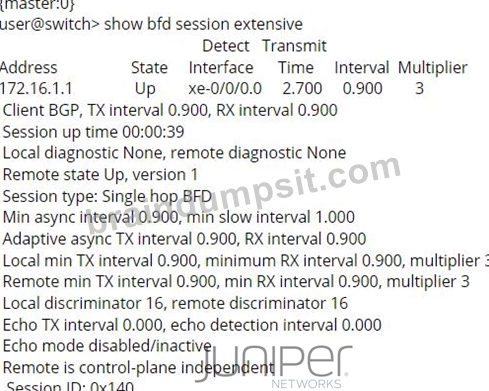
- A. BFD will bring down the BGP session if no BFD packets are received for 2700 milliseconds.
- B. BFD only records a syslog message if three BFD packets are missed.
- C. BFD will bring down the BGP session if no BFD packets are received for 2700 seconds.
- D. BFD packets are being sent every second.
Answer: A
NEW QUESTION # 108
Which statement is correct about the BGP AS path when advertising routes?
- A. The local AS number is added to the beginning of the AS path.
- B. The local AS number is added to the end of the AS path.
- C. The order of the AS path is only significant in IBGP.
- D. The order of the AS path is not significant.
Answer: A
Explanation:
The BGP AS (Autonomous System) path attribute is crucial in path selection and loop prevention. Each BGP router appends its local AS number to the beginning of the AS path when it advertises a route to an external BGP (eBGP) peer.
Step-by-Step Breakdown:
AS Path Attribute:
The AS path is a sequence of AS numbers that a route has traversed to reach a destination. Each AS adds its number to the front of the path, allowing BGP to track the route's history.
Why the Local AS is Added at the Beginning:
When advertising a route to an eBGP neighbor, a BGP router adds its own AS number to the beginning of the AS path. This ensures that the AS path reflects the route's journey accurately from the origin to the destination, and prevents loops in BGP. If the route returns to the same AS, the router will detect its AS number in the path and reject the route, preventing routing loops.
Order of the AS Path:
The order is significant because BGP uses it to select the best path. A shorter AS path is preferred, as it indicates fewer hops between the source and destination.
Juniper Reference:
AS Path Attribute: Junos devices append the local AS at the start of the AS path before advertising the route to an external peer.
NEW QUESTION # 109
During a BGP Graceful Restart, what happens to the routes learned from the restarting neighbor?
- A. They are advertised to other BGP neighbors.
- B. They are immediately removed from the routing table.
- C. They are marked as stale but kept in the routing table.
- D. Their metric is increased to prevent their use.
Answer: C
NEW QUESTION # 110
In the Junos OS, what is the default behavior of a switch when it receives a frame with an unknown destination MAC address?
- A. It floods the frame out of all ports except the one it was received on.
- B. It sends the frame to its default gateway.
- C. It buffers the frame until the MAC address can be learned.
- D. It discards the frame.
Answer: A
NEW QUESTION # 111
What is the main purpose of Bidirectional Forwarding Detection (BFD)?
- A. to detect the forwarding protocol
- B. to determine if the forwarding routes are correct
- C. to detect network path failures
- D. to determine packet round-trip latency
Answer: C
Explanation:
Bidirectional Forwarding Detection (BFD) is a network protocol used to detect failures in the network path between two devices quickly.
Step-by-Step Breakdown:
Path Failure Detection:
BFD provides a low-overhead mechanism for detecting failures in forwarding paths across Layer 3 networks. It is much faster than traditional routing protocol timers and can detect failures within milliseconds.
BFD in Routing:
BFD can be integrated with routing protocols like OSPF, BGP, or IS-IS to trigger a faster convergence when a network path goes down.
Juniper
Reference: BFD Configuration: Juniper devices use BFD to monitor network paths and ensure fast failure detection, enhancing network resilience.
NEW QUESTION # 112
Fill in the blank: In BGP, a route received from an ___________ peer will not be advertised to another ___________ peer by default.
- A. Static, Dynamic
- B. EBGP, IBGP
- C. EBGP, EBGP
- D. IBGP, IBGP
Answer: D
NEW QUESTION # 113
What are two requirements for an IP fabric? (Choose two.)
- A. a single connection between each leaf
- B. a single connection between each spine and leaf
- C. a Layer 3 routing protocol
- D. a Layer 2 switching protocol
Answer: B,C
Explanation:
An IP fabric is a network architecture commonly used in data centers to provide scalable, high-throughput connectivity using a spine-leaf topology.
Step-by-Step Breakdown:
Layer 3 Routing Protocol:
An IP fabric relies on a Layer 3 routing protocol, typically BGP or OSPF, to provide routing between the leaf and spine switches. This ensures efficient traffic forwarding across the network.
Single Connection Between Spine and Leaf:
In an IP fabric, each leaf switch connects to every spine switch with a single connection. This ensures that traffic between any two leaf switches can travel through the spine layer in just two hops.
Juniper Reference:
Spine-Leaf Design: Juniper's IP fabric implementations are designed for scalability and low-latency routing, often using protocols like BGP for Layer 3 control.
NEW QUESTION # 114
Which two prefixes are contributing routes to a 10.20.0.0/18 aggregate route? (Choose two)
- A. 10.20.100.0/24
- B. 10.20.0.0/16
- C. 10.20.0.0/24
- D. 10.20.60.0/23
Answer: C,D
NEW QUESTION # 115
......
Pass Your Juniper Exam with JN0-281 Exam Dumps: https://passguide.braindumpsit.com/JN0-281-latest-dumps.html