


[May-2026] SAP C-THR81-2505 Exam: Basic Questions With Answers
New 2026 Realistic Free SAP C-THR81-2505 Exam Dump Questions and Answer
SAP C-THR81-2505 Exam Syllabus Topics:
| Topic | Details |
|---|---|
| Topic 1 |
|
| Topic 2 |
|
| Topic 3 |
|
| Topic 4 |
|
NEW QUESTION # 36
How do you trigger a business rule to populate the Standard Hours field from Legal Entity records in the Add New Employee wizard?
- A. Event Type: onInit; Base Object: Standard Hours
- B. Event Type: onEdit; Base Object: Employee Information
- C. Event Type: onSave: Base Object: Legal Entity
- D. Event Type: onChange; Base Object: Employee Information
Answer: A
Explanation:
To populate the Standard Hours field from Legal Entity records in the Add New Employee wizard, the business rule should be configured with:
Event Type: onInit
This event triggers the rule during the initialization phase of the Add New Employee wizard.
Base Object: Standard Hours
The rule applies to the Standard Hours field, pulling data from the Legal Entity record.
Other event types such as onChange, onEdit, or onSave are not appropriate for pre-populating fields during the Add New Employee process.
NEW QUESTION # 37
You want the Timezone field to be pre-populated when the location record is changed in Job Info. How do you configure this?
- A. Base Object: Location: Assigned to Timezone field as onChange
- B. Base Object: Job Information; Assigned to Timezone field as onChange
- C. Base Object: Job Information; Assigned to Location field as onChange
- D. Base Object: Location; Assigned to Timezone field as onSave
Answer: C
Explanation:
To pre-populate the Timezone field when the location record is changed in Job Information, you need to configure the association as follows:
Base Object: Job Information
Trigger Event: Assigned to the Location field with the event set to onChange.
This configuration ensures that whenever the Location field is updated in Job Information, the system triggers the logic to update and pre-populate the Timezone field based on the associated Location. The onChange event drives this functionality.
NEW QUESTION # 38
A customer has scheduled an HRIS sync job, which includes mapping of job titles, to run every Friday. On Tuesday, an employee's job title is changed via Manager Self-Service (MSS) to become effective on Thursday.
When will the synchronization happen?
- A. Saturday, the day after the sync job completes
- B. Tuesday, the day the transaction is entered
- C. Thursday, when the change becomes effective
- D. Friday, when the sync job completes
Answer: D
Explanation:
In SAP SuccessFactors Employee Central, the HRIS synchronization (sync) job is responsible for aligning data between different modules and ensuring consistency across the system. When an employee's job title is changed via Manager Self-Service (MSS) with an effective date set to Thursday, and the HRIS sync job is scheduled to run every Friday, the synchronization will occur on Friday, when the sync job completes.
This means that any changes made effective on Thursday will be synchronized during the next scheduled HRIS sync job on Friday. Therefore, the correct answer is C. Friday, when the sync job completes.
NEW QUESTION # 39
How does the system validate the destination object for composite associations?
- A. The system validates if the destination object has effective dating set to Multiple Changes Per Day.
- B. The system validates if the destination object has effective dating set to Basic.
- C. The system validates if the destination object has effective dating set to None.
- D. The system validates if the destination object has effective dating set to From Parent.
Answer: D
Explanation:
In SAP SuccessFactors Employee Central, when configuring composite associations, the system validates that the destination object has its effective dating set to "From Parent." This setting ensures that the effective dates of the associated records are synchronized with the parent object, maintaining data consistency across related entities.
This validation is crucial because it ensures that any changes in the parent object's effective dates are appropriately reflected in the associated child objects, thereby preserving the integrity of historical data and future-dated records.
NEW QUESTION # 40
Which rule can effectively catch all unspecified events in a transaction?
- A. Option C
- B. Option B
- C. Option A
- D. Option D
Answer: B
Explanation:
The rule in Option B effectively captures all unspecified events in a transaction because:
It sets the Event Reason Value to "Data Change" whenever the Event Reason Value is null.
This ensures that all unplanned or unspecified events are assigned a default action, which is crucial for maintaining data consistency and avoiding errors during transactions.
Scenario 1: HR Transaction Rules
NEW QUESTION # 41
You need to create a one-to-many association from Location to Legal Entity. You also need to configure filtering of the Location field based on the Company field in the Job Information block.
What do you need to add to the data models? Note: There are 2 correct answers to this question.
- A. <association> as part of <hris-element id="location">
- B. <field-criteria> as part of <hris-field="company">
- C. <association> as part of <hris-element id="jobInfo">
- D. <field-criteria> as part of <hris-field="location">
Answer: A,D
Explanation:
To establish a one-to-many association from Location to Legal Entity and enable filtering of the Location field based on the Company field in the Job Information block, the following configurations are necessary:
Define the Association in the Location Object:
In the location object definition, add an <association> element to link it to the legalEntity object. This association should be defined within the <hris-element id="location"> section.
Configure Field Criteria for the Location Field:
Within the Job Information (jobInfo) element, add a <field-criteria> element as part of the <hris-field id="location">. This configuration ensures that the Location field is filtered based on the selected Company (Legal Entity) in the Job Information block.
Therefore, the correct answers are:
B: <field-criteria> as part of <hris-field id="location">
D: <association> as part of <hris-element id="location">
These configurations align with the standard practices for setting up associations and field criteria in SAP SuccessFactors Employee Central.
NEW QUESTION # 42
An employee will be changing their nationality information on their own How do you build the IF condition in the business rule so they can do this?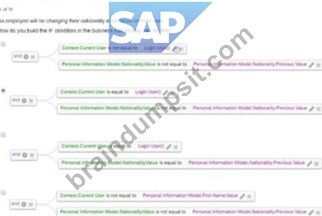
- A. Option C
- B. Option B
- C. Option A
- D. Option D
Answer: B
Explanation:
In order for an employee to change their nationality information on their own, the IF condition must:
Validate that the Context.Current User is equal to Login User (ensures that the logged-in user is making the changes).
Check if the Nationality.Value is not equal to the Nationality.Previous Value (ensures that a change is being made).
Scenario 2: Approvals for Self-Service
NEW QUESTION # 43
How do you create country/region-specific fields (CSF) for a country that does NOT have pre- delivered Legal Entity CSF fields? Note: There are 3 correct answers to this question.
- A. Update the condition and condition values of the association.
- B. Create a new generic object.
- C. Create a composite association to the new generic object on Legal Entity.
- D. Update the field criteria of the association.
- E. Create a composite association on the new generic object to Legal Entity.
Answer: B,C,D
Explanation:
To create country/region-specific fields (CSF) for a country that does not have pre-delivered Legal Entity CSF fields, follow these steps:
Create a New Generic Object: Develop a new generic object to define the specific fields required for the country/region. This object will store the additional data fields pertinent to the Legal Entity.
Create a Composite Association to the New Generic Object on Legal Entity: Establish a composite association from the Legal Entity to the newly created generic object. This association links the Legal Entity to the country/region-specific fields, enabling the system to recognize and utilize these fields appropriately.
Update the Field Criteria of the Association: Modify the field criteria within the association to ensure that the new fields are correctly associated with the Legal Entity. This step involves setting conditions that determine when the new fields are applicable, based on factors such as country/region.
These steps align with the standard procedures for extending the data model in SAP SuccessFactors Employee Central to accommodate country/region-specific requirements.
NEW QUESTION # 44
The HR admin has to change the salary of an employee, which will trigger a workflow for the employee's manager. The employee's manager should be able to edit the transaction if the proposed amount is NOT correct.
Where in the workflow do you need to define this?
Refer to the screenshot to answer the question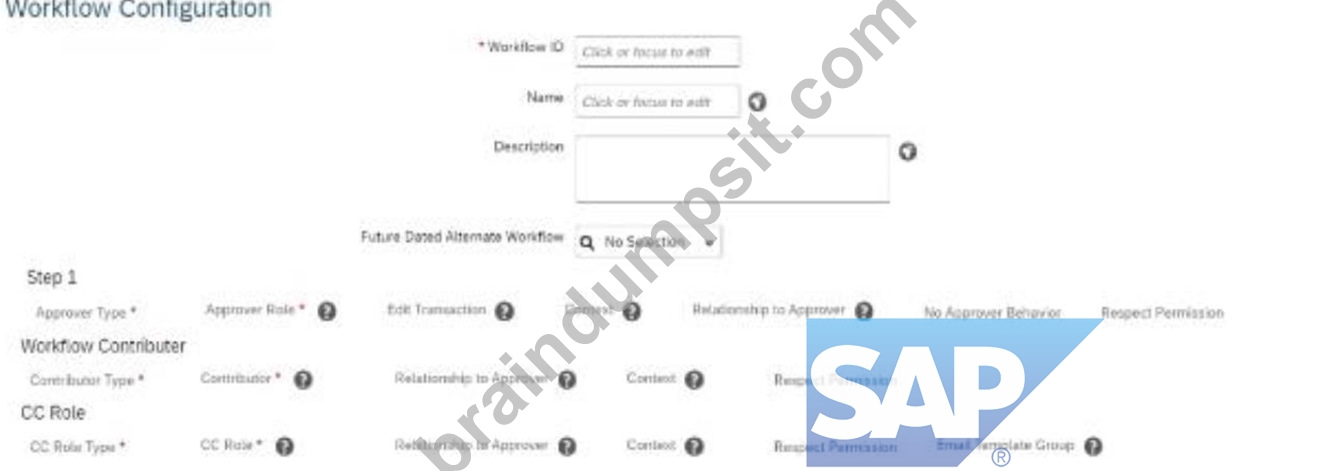
- A. No Approver Behavior
- B. Edit Transaction
- C. Context
- D. Respect Permission
Answer: B
Explanation:
To allow the employee's manager to edit a transaction in a workflow if the proposed salary change is incorrect, you must configure the "Edit Transaction" setting in the workflow.
The "Edit Transaction" option is part of the workflow configuration in Step 1 (as shown in the screenshot).
When enabled, it allows the approver (in this case, the manager) to make adjustments to the transaction before approving it.
Scenario 2: Approvals for Self-Service
NEW QUESTION # 45
Which of the following are features of the clean core dashboard? Note: There are 2 correct answers to this question.
- A. Customers can use the dashboard in the dev, test, and production tenants.
- B. It can be used in all SAP S/4HANA Cloud editions.
- C. Customers can grant access to the dashboard to partners.
- D. It can be accessed by using SAP For Me.
Answer: C,D
Explanation:
The clean core dashboard offers tools to monitor and maintain clean core operations.
Access via SAP For Me: The dashboard can be reached through the SAP For Me portal, a customer-centric interface for managing SAP environments.
Partner Access: Customers can grant partners access to the clean core dashboard, allowing collaborative management and monitoring.
The dashboard's functionality in specific tenants (like dev, test, production) or availability across all SAP S/4HANA Cloud editions depends on the specific system configurations.
NEW QUESTION # 46
An employee will be changing their nationality information on their own How do you build the IF condition in the business rule so they can do this?
- A. Option C
- B. Option B
- C. Option A
- D. Option D
Answer: B
Explanation:
In order for an employee to change their nationality information on their own, the IF condition must:
Validate that the Context.Current User is equal to Login User (ensures that the logged-in user is making the changes).
Check if the Nationality.Value is not equal to the Nationality.Previous Value (ensures that a change is being made).
Scenario 2: Approvals for Self-Service
NEW QUESTION # 47
Which method of modifying employee data will trigger an event reason derivation?
- A. Inserting a new record in history UI
- B. Deleting a record in history UI
- C. Using Actions menu in People Profile
- D. Using Add New Hire
Answer: C
Explanation:
Event Reason Derivation in SAP SuccessFactors Employee Central is triggered when changes are made to employee data through specific actions. Utilizing the "Actions" menu in the People Profile to update employee information initiates the Event Reason Derivation process. This mechanism automatically determines the appropriate event reason based on the nature of the data change.
In contrast, inserting a new record via the history UI, deleting a record in the history UI, or using the "Add New Hire" function does not trigger Event Reason Derivation. These actions either bypass the derivation process or involve scenarios where event reasons are manually selected.
Therefore, the correct answer is:
B: Using Actions menu in People Profile
This approach ensures that event reasons are accurately derived and recorded in line with the configured business rules in SAP SuccessFactors Employee Central.
NEW QUESTION # 48
How do you trigger a business rule to populate the Standard Hours field from Legal Entity records in the Add New Employee wizard?
- A. Event Type: onInit; Base Object: Standard Hours
- B. Event Type: onEdit; Base Object: Employee Information
- C. Event Type: onSave: Base Object: Legal Entity
- D. Event Type: onChange; Base Object: Employee Information
Answer: A
Explanation:
To populate the Standard Hours field from Legal Entity records in the Add New Employee wizard, the business rule should be configured with:
Event Type: onInit
This event triggers the rule during the initialization phase of the Add New Employee wizard.
Base Object: Standard Hours
The rule applies to the Standard Hours field, pulling data from the Legal Entity record.
Other event types such as onChange, onEdit, or onSave are not appropriate for pre-populating fields during the Add New Employee process.
NEW QUESTION # 49
Your client is live with the employee transfer process in the production instance. The workflow shown in the screenshot is triggered when an employee transfer is initiated.
What is the expected behavior of this workflow?
- A. The initiator of the employee transfer process is given an option to choose New Hire Workflow as an alternate workflow to WF_Employee_Transfer.
- B. An approver can automatically reroute this request to another employee during vacation.
- C. The alternate workflow is used when there is a future-dated record entered for the employee.
- D. If an approver does NOT take any action for 3 days, a reminder notification is sent by the system.
Answer: C
Explanation:
In the scenario where an employee transfer process is initiated, and a workflow is triggered, the system behavior is as follows:
Alternate Workflow Usage: If there is a future-dated record entered for the employee, the system utilizes the alternate workflow. This mechanism ensures that the appropriate workflow is applied based on the effective date of the transaction, allowing for accurate processing of future-dated changes.
This functionality is designed to handle scenarios where actions need to be taken in advance, ensuring that the system processes the correct workflow when the future-dated record becomes effective.
NEW QUESTION # 50
Which rule can effectively catch all unspecified events in a transaction?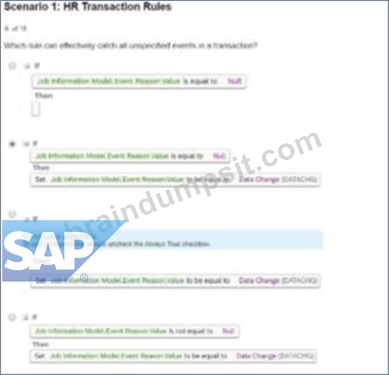
- A. Option C
- B. Option B
- C. Option A
- D. Option D
Answer: B
Explanation:
The rule in Option B effectively captures all unspecified events in a transaction because:
It sets the Event Reason Value to "Data Change" whenever the Event Reason Value is null.
This ensures that all unplanned or unspecified events are assigned a default action, which is crucial for maintaining data consistency and avoiding errors during transactions.
Scenario 1: HR Transaction Rules
NEW QUESTION # 51
In which business rule scenario do you use model base objects? Note: There are 2 correct answers to this question.
- A. Trigger Workflows
- B. Save Changes to Foundation Objects
- C. Trigger Rules for Hire/Rehire
- D. Trigger Rules to Display Internal Job History
Answer: A,C
Explanation:
In SAP SuccessFactors Employee Central, model base objects are utilized in business rules for scenarios such as:
A . Trigger Workflows
Model base objects can be used to define conditions that initiate workflows, automating processes based on specific data changes or events.
C . Trigger Rules for Hire/Rehire
During the hire or rehire process, model base objects help in setting default values, validating data, and enforcing business logic to ensure compliance with organizational policies.
Options B and D are not typically associated with model base objects in business rules:
B . Trigger Rules to Display Internal Job History
Displaying internal job history is generally managed through reporting and does not involve model base objects in business rules.
D . Save Changes to Foundation Objects
While foundation objects are essential for organizational data, saving changes to them does not typically require the use of model base objects in business rules.
NEW QUESTION # 52
When the manager updates the location of an employee, the HR admin must be the approver Note that the HR admin, manager, and HR Business Partner have access to change the location.
How do you create the IF condition for the workflow derivation rule lo meet the above requirements?
- A. Option C
- B. Option B
- C. Option D
- D. Option A
Answer: D
Explanation:
To meet the requirement where the HR admin must approve the manager's updates to an employee's location, the workflow derivation rule must include the following IF condition:
Option A: Ensures that the condition checks whether the user belongs to the permission group for HR Admins, and the Event Reason value matches "Location Change".
This configuration aligns the workflow rule with the scenario requirements, where HR admins are explicitly designated as approvers Scenario 2: Approvals for Self-Service
NEW QUESTION # 53
How should you build the IF condition to identity the user when the employee is updating their own Personal Information?
- A. Option C
- B. Option B
- C. Option A
- D. Option D
Answer: A
Explanation:
To identify the user when the employee is updating their own personal information, the IF condition in Option C is correct. This configuration:
Checks if the Context.Current User is equal to the Login User.
Ensures that the rule applies only when the employee is making changes to their own personal data.
This approach is aligned with SAP SuccessFactors logic for self-service scenarios, enabling accurate identification of the user in such workflows.
Scenario 2: Approvals for Self-Service
NEW QUESTION # 54
Which fields are required when importing Personal Information? Note: There are 2 correct answers to this question.
- A. User Id
- B. Personal Id External
- C. Username
- D. Event Date
Answer: B,D
Explanation:
When importing Personal Information into SAP SuccessFactors Employee Central, the following fields are mandatory:
B . Event Date
This field specifies the effective date of the personal information record. It is crucial for maintaining accurate historical data and ensuring that changes are applied from the correct date.
SAP Help Portal
D . Person Id External
The person-id-external serves as a unique identifier for the individual across all employment records within the system. It is essential for linking personal information to the correct person.
SAP Help Portal
Options A and C are not required for importing Personal Information:
A . Username
The username is associated with system login credentials and is not a required field for importing personal information.
C . User Id
The user-id pertains to employment records and is not mandatory for the Personal Information import process.
NEW QUESTION # 55
Which mathematical formula must be set in the THEN condition to meet the Jobinfo_FTE_Comp rule requirement?
- A. (Base Salary/Current FTE Value) X Previous FTE Value
- B. (Current FTE Value-Previous FTE Value)/Base Salary
- C. (Base Salary/Previous FTE Value) X Current FTE Value
- D. (Previous FTE Value - Current FTE Value) X Base Salary
Answer: C
Explanation:
The formula (Base Salary / Previous FTE Value) X Current FTE Value ensures that the base salary is adjusted correctly when there is a change in the Full-Time Equivalent (FTE) value. This formula maintains salary proportionality by recalculating the base salary based on the ratio of the new FTE value to the previous FTE value. It is critical in cases where FTE adjustments impact an employee's compensation.
Scenario 1: HR Transaction Rules
NEW QUESTION # 56
......
Guaranteed Success in SAP Certified Associate C-THR81-2505 Exam Dumps: https://passguide.braindumpsit.com/C-THR81-2505-latest-dumps.html