


[Nov 26, 2024] SPLK-1005 Sample with Accurate & Updated Questions
SPLK-1005 Exam Info and Free Practice Test | BraindumpsIT
Splunk SPLK-1005 certification is an excellent way for professionals to demonstrate their expertise in managing and administering Splunk Cloud. Splunk Cloud Certified Admin certification is highly valued by employers and can help professionals advance their careers in the field. Splunk Cloud Certified Admin certification also provides access to Splunk's global community of certified professionals, where candidates can network and learn from other experts in the field.
NEW QUESTION # 14
How are HTTP Event Collector (HEC) tokens configured in a managed Splunk Cloud environment?
- A. Open a support case for each new data input and a token will be provided.
- B. Obtain a token from the organization's application developers and apply it in Settings > Data Inputs > HTTP Event Collector > New Token.
- C. A token is generated when configuring a HEC input, which should be provided to the application developers.
- D. Any token will be accepted by HEC, the data may just end up in the wrong index.
Answer: C
Explanation:
In a managed Splunk Cloud environment, HTTP Event Collector (HEC) tokens are configured by an administrator through the Splunk Web interface. When setting up a new HEC input, a unique token is automatically generated. This token is then provided to application developers, who will use it to authenticate and send data to Splunk via the HEC endpoint.
This token ensures that the data is correctly ingested and associated with the appropriate inputs and indexes.
Unlike the other options, which either involve external tokens or support cases, option B reflects the standard procedure for configuring HEC tokens in Splunk Cloud, where control over tokens remains within the Splunk environment itself.
Splunk Cloud Reference:Splunk's documentation on HEC inputs provides detailed steps on creating and managing tokens within Splunk Cloud. This includes the process of generating tokens, configuring data inputs, and distributing these tokens to application developers.
Source:
* Splunk Docs: HTTP Event Collector in Splunk Cloud Platform
* Splunk Docs: Create and manage HEC tokens
NEW QUESTION # 15
A Splunk Cloud administrator is looking to allow a new group of Splunk users in the marketing department to access the Splunk environment and view a dashboard with relevant data. These users need to access marketing data (stored in the marketing_data index), but shouldn't be able to access other data, such as events related to security or operations.
Which approach would be the best way to accomplish these requirements?
- A. Create a new role that inherits the user role and remove the capability to search indexes other than marketing_data.
- B. Create a new role that does not inherit from any other role, turn on the same capabilities as the user role, and assign access to the marketing_data index.
- C. Create a new userwith access to the marketing_dataindex assigned.
- D. Create a new role that inherits the admin rote and assign access to the marketing_dat.a index.
Answer: A
Explanation:
The best approach to meet the requirements of the marketing department is to create a new role that inherits the user role but with restricted access to only the marketing_data index. This setup allows users to perform searches and view dashboards while ensuring they cannot access other indexes such as those containing security or operations data.
Splunk Documentation Reference: Splunk Role-based Access Control
NEW QUESTION # 16
Which of the following tasks is the responsibility of a Splunk Cloud administrator?
- A. Configuring deployer
- B. Configuring cluster master
- C. Configuring indexes
- D. Configuring indexers
Answer: C
Explanation:
In Splunk Cloud, configuring indexes is one of the primary responsibilities of a Splunk Cloud administrator.
This task includes setting up new indexes, managing retention policies, and configuring index settings as required by the organization's data retention and compliance policies. Other tasks like configuring deployer, cluster master, or indexers are typically handled by Splunk Enterprise administrators, not Splunk Cloud administrators.
Splunk Documentation Reference: Splunk Cloud Administrator Guide
NEW QUESTION # 17
Which setting in inputs.conf can be used to specify the maximum size of a file that can be monitored by Splunk?
- A. max_file_count
- B. max_file_bytes
- C. max_file_size
- D. max_file_age
Answer: C
NEW QUESTION # 18
Which command can be used to install the Splunk universal forwarder credentials package on the universal forwarder machine?
- A. splunk add app <path_to_credentials_package>
- B. splunk add forwarder-credentials <path_to_credentials_package>
- C. splunk install app <path_to_credentials_package>
- D. splunk install forwarder-credentials <path_to_credentials_package>
Answer: C
NEW QUESTION # 19
What is the name of the configuration file where you can specify the source type for a data input?
- A. props.conf
- B. limits.conf
- C. transforms.conf
- D. inputs.conf
Answer: D
NEW QUESTION # 20
Which feature of forwarders can improve the network performance and reduce the bandwidth consumption?
- A. Data compression
- B. Data filtering
- C. SSL security
- D. Data sampling
Answer: A
NEW QUESTION # 21
By default, which of the following capabilities are granted to the sc_admin role?
- A. indexes_edit, edit___token, admin_all_objects, delete_by_keyword
- B. indexes_edit, edit_token_http, admin _all objects, edit limits_conf
- C. indexes_edit, fsh_manage, admin_all_objects can_delete
- D. indexes_edit, fsh_manage, acs_conf, list_indexesdiscovert
Answer: C
Explanation:
By default, the sc_admin role in Splunk Cloud is granted several important capabilities, including:
* indexes_edit: The ability to create, edit, and manage indexes.
* fsh_manage: Manage full-stack monitoring integrations.
* admin_all_objects: Full administrative control over all objects in Splunk.
* can_delete: The ability to delete events using the delete command.
Option C correctly lists these default capabilities for the sc_admin role.
Splunk Documentation Reference: User roles and capabilities
NEW QUESTION # 22
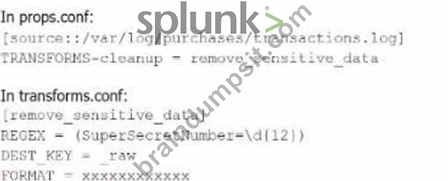
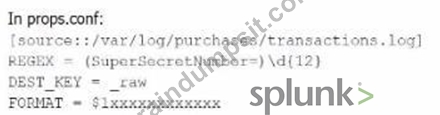
A user has been asked to mask some sensitive data without tampering with the structure of the file /var/log
/purchase/transactions. log that has the following format:
- A.

- B.
- C.

- D.
Answer: C
Explanation:
Option B is the correct approach because it properly uses a TRANSFORMS stanza in props.conf to reference the transforms.conf for removing sensitive data. The transforms stanza in transforms.conf uses a regular expression (REGEX) to locate the sensitive data (in this case, the SuperSecretNumber) and replaces it with a masked version using the FORMAT directive.
In detail:
* props.confrefers to the transforms.conf stanza remove_sensitive_data by setting TRANSFORMS- cleanup = remove_sensitive_data.
* transforms.confdefines the regular expression that matches the sensitive data and specifies how the sensitive data should be replaced in the FORMAT directive.
This approach ensures that sensitive information is masked before indexing without altering the structure of the log files.
Splunk Cloud Reference:For further reference, you can look at Splunk's documentation regarding data masking and transformation through props.conf and transforms.conf.
Source:
* Splunk Docs: Anonymize data
* Splunk Docs: Props.conf and Transforms.conf
NEW QUESTION # 23
Which configuration file needs to be edited to enable local indexing on the forwarder?
- A. props.conf
- B. outputs.conf
- C. transforms.conf
- D. inputs.conf
Answer: B
NEW QUESTION # 24
Which type of forwarder can act as an intermediate forwarder to receive data from other forwarders and send it to the indexer?
- A. Any type of forwarder
- B. Universal forwarder
- C. Light forwarder
- D. Heavy forwarder
Answer: D
NEW QUESTION # 25
Which type of forwarder is a legacy option that is not recommended for new deployments?
- A. Light forwarder
- B. Universal forwarder
- C. Deployment client
- D. Heavy forwarder
Answer: A
NEW QUESTION # 26
Which feature of forwarders can protect the data from unauthorized access or tampering?
- A. Data masking
- B. Data encryption
- C. SSL security
- D. Data compression
Answer: C
NEW QUESTION # 27
Which command can be used to download and install the universal forwarder software on a Linux system?
- A. All of the above
- B. wget -O splunkforwarder-<version>-Linux-x86_64.tgz
'https://www.splunk.com/bin/splunk/DownloadActivityServlet?architecture=x86_64&platform=linux&ve - C. /opt/splunkforwarder/bin/splunk start --accept-license
- D. tar xvzf splunkforwarder-<version>-Linux-x86_64.tgz -C /opt
Answer: A
NEW QUESTION # 28
When monitoring directories that contain mixed file types, which setting should be omitted from inputs, conf and instead be overridden in propo.conf?
- A. index
- B. host
- C. sourcetype
- D. source
Answer: C
Explanation:
When monitoring directories containing mixed file types, the sourcetype should typically be overridden in props.conf rather than defined in inputs.conf. This is because sourcetype is meant to classify the type of data being ingested, and when dealing with mixed file types, setting a single sourcetype in inputs.conf would not be effective for accurate data classification. Instead, you can use props.conf to define rules that apply different sourcetypes based on the file path, file name patterns, or other criteria. This allows for more granular and accurate assignment of sourcetypes, ensuring the data is properly parsed and indexed according to its type.
Splunk Cloud Reference:For further clarification, refer to Splunk's official documentation on configuring inputs and props, especially the sections discussing monitoring directories and configuring sourcetypes.
Source:
* Splunk Docs: Monitor files and directories
* Splunk Docs: Configure event line breaking and input settings with props.conf
NEW QUESTION # 29
At what point in the indexing pipeline set is SEDCMD applied to data?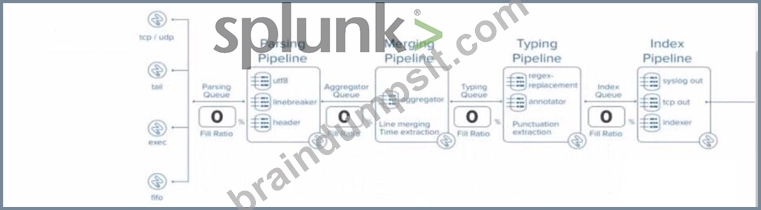
- A. In the typing pipeline
- B. In the exec pipeline
- C. In the aggregator queue
- D. In the parsing queue
Answer: A
Explanation:
In Splunk, SEDCMD (Stream Editing Commands) is applied during theTyping Pipelineof the data indexing process. The Typing Pipeline is responsible for various tasks, such as applying regular expressions for field extractions, replacements, and data transformation operations that occur after the initial parsing and aggregation steps.
Here's how the indexing process works in more detail:
* Parsing Pipeline:In this stage, Splunk breaks incoming data into events, identifies timestamps, and assigns metadata.
* Merging Pipeline:This stage is responsible for merging events and handling time-based operations.
* Typing Pipeline:The Typing Pipeline is where SEDCMD operations occur. It applies regular expressions and replacements, which is essential for modifying raw data before indexing. This pipeline is also responsible for field extraction and other similar operations.
* Index Pipeline:Finally, the processed data is indexed and stored, where it becomes available for searching.
Splunk Cloud Reference:To verify this information, you can refer to the official Splunk documentation on the data pipeline and indexing process, specifically focusing on the stages of the indexing pipeline and the roles they play. Splunk Docs often discuss the exact sequence of operations within the pipeline, highlighting when and where commands like SEDCMD are applied during data processing.
Source:
* Splunk Docs: Managing Indexers and Clusters of Indexers
* Splunk Answers: Community discussions and expert responses frequently clarify where specific operations occur within the pipeline.
NEW QUESTION # 30
Which option can be used to specify the host value of the data when creating a file or directory monitor input?
- A. Set Host
- B. Choose Host
- C. Define Host
- D. Select Host
Answer: A
NEW QUESTION # 31
......
The SPLK-1005 exam is intended for individuals who have a solid understanding of Splunk fundamentals, including how to create searches, reports, and dashboards, as well as how to use Splunk's search processing language (SPL). Candidates should also have experience with Splunk Cloud, including how to deploy and configure Splunk Cloud instances.
Pass Splunk SPLK-1005 Premium Files Test Engine pdf - Free Dumps Collection: https://passguide.braindumpsit.com/SPLK-1005-latest-dumps.html