


[Oct 13, 2022] Free Google Cloud-Digital-Leader Exam Questions and Answer
Verified Cloud-Digital-Leader dumps Q&As Latest Cloud-Digital-Leader Download
NEW QUESTION 22
Which Firebase quality tools help the developer track, prioritize & fix stability issues that erode the application quality?
- A. Test Lab
- B. Performance
- C. Crashlytics
- D. App Distribution
Answer: C
Explanation:
Firebase Crashlytics:
Get clear, actionable insight into app issues with this powerful crash reporting solution for iOS, Android, and Unity.
Firebase Crashlytics is a lightweight, real-time crash reporter that helps you track, prioritize, and fix stability issues that erode your app quality. Crashlytics saves you troubleshooting time by intelligently grouping crashes and highlighting the circumstances that lead up to them.
Find out if a particular crash is impacting a lot of users. Get alerts when an issue suddenly increases in severity. Figure out which lines of code are causing crashes.
NEW QUESTION 23
Your organization needs to ensure that the Google Cloud resources of each of your departments are segregated from one another. Each department has several environments of its own: development, testing, and production. Which strategy should your organization choose?
- A. Create a Cloud Identity domain per department, and create a project per environment in each domain.
- B. Create a project per department, and create a folder per environment in each project.
- C. Create a folder per department, and create a project per environment in each folder.
- D. Create a Cloud Identity domain per environment, and create a project per department in each domain.
Answer: D
NEW QUESTION 24
A customer has a tens of applications that are dependent on Oracle databases in their on-premise data centers. The customer wants to migrate to Google Cloud. Their long term goal is to move to other cloud native database technologies. What options do they have to initially move their data?
- A. Since there is no hosted Oracle solution, leave the Oracle data on-premise while doing analytics on Google Cloud.
- B. Containerize Oracle and run it using Cloud Run.
- C. Migrate to Cloud SQL.
- D. Migrate to a Bare Metal server.
Answer: C
Explanation:
The Bare Metal solution is the recommended approach. You can deploy Oracle capabilities like clustered databases, replication, and all performance features at licensing costs that are similar to on-premise systems
https://cloud.google.com/architecture/migrating-bare-metal-workloads
NEW QUESTION 25
Which of the following is / are true for Preemptible Instances.
- A. Preemptible instances can't live migrate to a regular VM instance, or be set to au-tomatically restart when there is a maintenance event.
- B. Google Cloud Free Tier credits for compute engine do not apply to preemptible in-stances.
- C. All of the above.
- D. Preemptible Instances have no Service Level Agreement (Compute Engine SLA).
Answer: C
Explanation:
Preemptible instances function like normal instances but have the following limitations:
-> Compute Engine might stop preemptible instances at any time due to system events. The probability that Compute Engine will stop a preemptible instance for a system event is generally low, but might vary from day to day and from zone to zone depending on current conditions.
-> Compute Engine always stops preemptible instances after they run for 24 hours. Certain actions reset this 24-hour counter.
-> Preemptible instances are finite Compute Engine resources, so they might not always be available.
-> Preemptible instances can't live migrate to a regular VM instance, or be set to automatically restart when there is a maintenance event.
-> Due to the above limitations, preemptible instances are not covered by any Service Level Agreement (and, for clarity, are excluded from the Compute Engine SLA).
-> The Google Cloud Free Tier credits for Compute Engine do not apply to preemptible instances.
NEW QUESTION 26
Which of the following is/are true about Bare Metal Solutions?
- A. Continue to run any version, and feature set, any database option, and any cus-tomizations (patchsets)
- B. All of the Above.
- C. All your existing investment in tooling and best practices will work as is
- D. Enterprise-grade deployment platform
Answer: B
Explanation:
Bare Metal Solution for Oracle
Bring your Oracle workloads to Google Cloud with Bare Metal Solution and jumpstart your cloud journey with minimal risk.
- Continue to run any version, any feature set, any database option, and any customizations (patchsets)
- Enterprise-grade deployment platform
- High availability with Oracle RAC
- Works with any application, any Oracle versions
- All your existing investment in tooling and best practices will work as is
NEW QUESTION 27
Your company is running the majority of its workloads in a co-located data center. The workloads are running on virtual machines (VMs) on top of a hypervisor and use either Linux or Windows server editions. As part of your company's transformation strategy, you need to modernize workloads as much as possible by adopting cloud-native technologies. You need to migrate the workloads into Google Cloud.
What should you do?
- A. Export the VMs into VMDK format, and import them into Compute Engine
- B. Migrate the workloads using Migrate for Anthos
- C. Export the VMs into VMDK format, and import them into Google Cloud VMware Engine
- D. Migrate the workloads using Migrate for Compute Engine
Answer: D
Explanation:
Migrate for Compute Engine is a product for migrating physical servers and virtual machines from on-premises and cloud environments to Google Cloud. Migrate for Compute Engine lets you migrate a virtual machine to Google Cloud in a few minutes, where the data is copied in the background but the virtual machines are completely operational.
NEW QUESTION 28
A fitness band company is continuously ingesting data from millions of its consumers. Different kinds of data based on time, like location, heartbeat rate, temperature, movement, etc. are connect-ed. They need a high throughput database that can write data very fast. Since their users are spread across the world, they need the database to be geographically scalable. Consumers also want to see near-real-time visualizations of their activities. Which of these databases would be a good fit?
- A. Bigtable
- B. Spanner
- C. Firestore
- D. Cloud SQL
Answer: A
Explanation:
Bigtable is the best suited for time series data. It also has high read-write throughput and ability to scale globally.
NEW QUESTION 29
Your organization is moving an application to Google Cloud. As part of that effort, it needs to migrate the application's working database from another cloud provider to Cloud SQL. The database runs on the MySQL engine. The migration must cause minimal disruption to users. Data must be secured while in transit.
Which should your organization use?
- A. Cloud Composer
- B. MySQL batch insert
- C. BigQuery Data Transfer Service
- D. Database Migration Service
Answer: D
NEW QUESTION 30
A financial services company is running an experimental application workload that has a very large number of mathematical calculations involving floating-point numbers. The current application that is running on compute engine is not providing enough speed and throughput. What are the options to increase the processing performance?
- A. Use a serverless option like Cloud Functions that will automatically scale as much as required.
- B. Since processing could also be dependent on reading and writing data to the disk, use a fast Local SSD.
- C. Instead of using a "general purpose" machine family, use "compute-optimized" machine family.
- D. Attach GPUs to the virtual machine for number crunching.
Answer: D
Explanation:
Compute Engine provides graphics processing units (GPUs) that you can add to your virtual machines (VMs). You can use these GPUs to accelerate specific workloads on your VMs such as machine learning and data processing.
https://cloud.google.com/compute/docs/gpus
NEW QUESTION 31
Your company has a requirement to run manual tests on their web products for UX research before it is released to end customers. The people who will do the tests are external to the company. They will either use their own Gmail id or be given temporary email ids using the applications and record-ing their inputs in another app. The UX testing is done in the last week of the month. Each month the UX testers could be different. How should the IT team manage the users?
- A. Since the app is anyways going to be public, create permanent credentials for the UX testers that they can conveniently use each time.
- B. It would be a security issue to have users come and go. Recommend that the test-ers be permanently hired to plug the vulnerability issue.
- C. It would be a security issue to have users come and go. Recommend that the test-ers be permanently hired to plug the vulnerability issue.
- D. Create a Group with the permissions required to do the test and record their in-puts. When users arrive each week, add them to the group and after the testing period, remove them from the group.
Answer: D
Explanation:
Groups are convenient to use for this requirement. Permissions to the group are automatically inherited by the members of the group. Adding and removing UX testers from the group will grant and remove permissions.
NEW QUESTION 32
An organization wants to scale their existing virtual machine architecture as quickly as possible. Why should the organization use VMware Engine?
- A. To replatform virtual machines as they are.
- B. To migrate virtual machines to containers.
- C. To archive virtual machine instances.
- D. To deploy custom APIs seamlessly.
Answer: A
Explanation:
VMware Engine helps migrate and run virtual machines in Google Cloud with minimal changes to the VM architecture.
https://cloud.google.com/learn/what-is-a-virtual-machine
NEW QUESTION 33
A large travel company has thus far invested heavily in their technology team. There is strategic pressure on the company to focus on their core business and innovate to survive in certain geogra-phies and thrive in others. They are evaluating whether a move to Google Cloud will be good for them. Which of these reasons would be relevant for them? (choose two answer)
- A. Application architecture won't be too involved because of serverless options.
- B. The IT team won't have to work on procuring and provisioning new hardware and refreshes to existing hardware.
- C. The IT team won't have to manage software upgrades, security patches, etc. for the VMs.
- D. Budgeting won't be an issue since the cloud takes care of billing.
Answer: B,C
NEW QUESTION 34
"With cloud messaging you can Customize and deliver messages accordingly to the predetermined time in the user's local time zone." Comment on the above statement.
- A. The above statement is partially true.
- B. The above statement is completely true.
- C. This statement is undefined.
- D. The above statement is completely false.
Answer: B
Explanation:
Firebase Cloud Messaging:
Firebase Cloud Messaging (FCM) is a cross-platform messaging solution that lets you reliably send messages at no cost.
Using FCM, you can notify a client app that new email or other data is available to sync. You can send notification messages to drive user re-engagement and retention. For use cases such as instant messaging, a message can transfer a payload of up to 4000 bytes to a client app.
Key capabilities of Firebase Cloud Messaging:
Send notification messages or data messages: Send notification messages that are displayed to your user. Or send data messages and determine completely what happens in your application code.
Versatile message targeting: Distribute messages to your client app in any of 3 ways-to single devices, to groups of devices, or to devices subscribed to topics.
Send messages from client apps: Send acknowledgments, chats, and other messages from devices back to your server over FCM's reliable and battery-efficient connection channel.
NEW QUESTION 35
In terms of Dockers and Kubernetes, which of the following statements are correct?
- A. Kubernetes can be used with or without Docker.
- B. Difference between Docker and Kubernetes relates to the role each play in con-tainerizing and running your applications
- C. All of the above.
- D. Kubernetes uses Docker to deploy, manage, and scale containerized applications.
Answer: C
Explanation:
Kubernetes vs. Docker
Often misunderstood as a choice between one or the other, Kubernetes and Docker are different yet complementary technologies for running containerized applications.
Docker lets you put everything you need to run your application into a box that can be stored and opened when and where it is required. Once you start boxing up your applications, you need a way to manage them; and that's what Kubernetes does.
Kubernetes is a Greek word meaning 'captain' in English. Like the captain is responsible for the safe journey of the ship in the seas, Kubernetes is responsible for carrying and delivering those boxes safely to locations where they can be used.
- Kubernetes can be used with or without Docker.
- Docker is not an alternative to Kubernetes, so it's less of a "Kubernetes vs. Docker" question. It's about using Kubernetes with Docker to containerize your applications and run them at scale.
- The difference between Docker and Kubernetes relates to the role each play in containerizing and running your applications.
- Docker is an open industry standard for packaging and distributing applications in containers.
- Kubernetes uses Docker to deploy, manage, and scale containerized applications.
NEW QUESTION 36
How do Migrate for Compute Engine and Migrate for Anthos differ?
- A. Migrate for Anthos migrates to containers, and Migrate for Compute Engine migrates to virtual machines.
- B. Migrate for Compute Engine is closed source, and Migrate for Anthos is open source.
- C. Unlike Migrate for Anthos, Migrate for Compute Engine assumes that the migration source is VMware vSphere.
- D. Migrate for Compute Engine charges for ingress, but Migrate for Anthos does not.
Answer: A
NEW QUESTION 37
Your organization wants to optimize its use of Google Cloud's discounts on virtual machine-based workloads. You plan to use 200 CPUs constantly for the next 3 years, and you forecast that spikes of up to 300 CPUs will occur approximately 30% of the time. What should you choose?
- A. 1-year committed use discount for 200 CPUs
- B. Regular pay-as-you-go pricing
- C. 3-year committed use discount for 300 CPUs
- D. 3-year committed use discount for 200 CPUs
Answer: D
Explanation:
you can get a 57% discount by agreeing to commit to a 3-year contract. Any usage over the commitment will just be billed at the standard rate. Since they only need 300 CPUs 30% of the time, will pick answer C so that we are not paying usage off 300 CPUs all of the time. This gives us a discount of 57% for 200 CPU's, huge cost savings.
NEW QUESTION 38
Your organization needs to plan its cloud infrastructure expenditures.
Which should your organization do?
- A. If your organization uses only cloud resources, infrastructure costs are no longer part of your overall budget
- B. Review cloud resource costs annually as part of planning your organization's overall budget
- C. Review cloud resource costs frequently, because costs change often based on use
- D. Involve fewer people in cloud resource planning than your organization did for on-premises resource planning
Answer: B
NEW QUESTION 39
A partner of yours used to have their own private data center. Your company was already on Google Cloud and now they have also moved to Google Cloud. You are investigating whether there are ways to collaborate better or shared services. What would be one good option to consider?
- A. Use public IP addresses as before. It will automatically be routed internally only.
- B. Use VPC Peering to share resources privately between your two organizations.
- C. Use VPC Shared Networks to share common resources.
- D. Use Private Service Access within Google Cloud.
Answer: B
Explanation:
VPC Network Peering allows internal IP address connectivity across two Virtual Private Cloud (VPC) networks regardless of whether they belong to the same project or the same organization.
-> Shared VPC is only within an organization - it allows an organization to connect resources from multiple projects to a common Virtual Private Cloud (VPC) network, so that they can communicate with each other securely and efficiently using internal IPs from that network.
-> Private Google Access is only to access Google APIs and services
References:
-> https://cloud.google.com/vpc/docs/vpc-peering
-> https://cloud.google.com/vpc/docs/private-google-access
-> https://cloud.google.com/vpc/docs/shared-vpc
NEW QUESTION 40
You decide to migrate your on-premises environment to the cloud. You need to determine which resource components still need to be assigned ownership.
Which two functions are owned by a public cloud provider? (Choose two.)
- A. Infrastructure deployment automation
- B. Fixing application security issues
- C. Infrastructure architecture
- D. Hardware capacity management
- E. Hardware maintenance
Answer: C,E
NEW QUESTION 41
Cloud SQL is a fully-managed relational database service for MySQL, PostgreSQL and SQL serv-ers, keeping Cloud SQL Google Cloud Service in mind, which of the following statements is/are correct?
- A. Cloud SQL automatically ensures your databases are reliable, secure, and scala-ble so that your business continues to run without disruption.
- B. Data inside cloud SQL is automatically Encrypted.
- C. With DMS (Database Migration Service) it becomes very easy to Migration of Pro-duction Database.
- D. All of the above
Answer: D
Explanation:
Cloud SQL
Fully managed relational database service for MySQL, PostgreSQL, and SQL Server. Run the exact same relational databases you know with their rich extension collections, configuration flags and developer ecosystem, but without the hassle of self management.
- Reduce maintenance cost with fully managed MySQL, PostgreSQL and SQL Server databases.
- Ensure business continuity with reliable and secure services backed by 24/7 SRE team.
- Automate database provisioning, storage capacity management, and other time-consuming tasks.
- Database observability made easy for developers with Cloud SQL Insights.
- Easy integration with existing apps and Google Cloud services like GKE and BigQuery.
Key features:
Fully managed
Cloud SQL automatically ensures your databases are reliable, secure, and scalable so that your business continues to run without disruption. Cloud SQL automates all your backups, replication, encryption patches, and capacity increases-while ensuring greater than 99.95% availability, anywhere in the world.
Integrated
Access Cloud SQL instances from just about any application. Easily connect from App Engine, Compute Engine, Google Kubernetes Engine, and your workstation. Open up analytics possibilities by using BigQuery to directly query your Cloud SQL databases.
Reliable
Easily configure replication and backups to protect your data. Go further by enabling automatic failover to make your database highly available. Your data is automatically encrypted, and Cloud SQL is SSAE 16, ISO 27001, and PCI DSS compliant and supports HIPAA compliance.
Easy migrations to Cloud SQL
Database Migration Service (DMS) makes it easy to migrate your production databases to Cloud SQL with minimal downtime. This serverless offering eliminates the manual hassle of provisioning, managing, and monitoring migration-specific resources. DMS leverages the native replication capabilities of MySQL and PostgreSQL to maximize the fidelity and reliability of your migration. And it's available at no additional charge for native like-to-like migrations to Cloud SQL.
NEW QUESTION 42
Your organization is running all its workloads in a private cloud on top of a hypervisor. Your organization has decided it wants to move to Google Cloud as quickly as possible. Your organization wants minimal changes to the current environment, while using the maximim amount of managed services Google offers.
What should your organization do?
- A. Migrate the workloads to Bare Metal Solution
- B. Migrate the workloads to Google Cloud VMware Engine
- C. Migrate the workloads to Compute Engine
- D. Migrate the workloads to Google Kubernetes Engine
Answer: C
Explanation:
Migrate for Compute Engine enables you to lift and shift workloads at scale to Google Cloud Compute Engine with minimal changes and risk.
NEW QUESTION 43
A customer has contacted you about migrating to Google Cloud. The customer would like to mi-grate their data from on premises as soon as possible. They don't have the budget to rewrite code, and they want the most direct route. What migration option should suggest to the customer?
- A. Improve and Move
- B. None, since the customer is not cloud native ready.
- C. Lift and Shift
- D. Rip and Replace
Answer: C
Explanation:
With Lift and Shift migrations, the customer could move workloads from a source environment to a target environment with few or no modifications or refactoring
https://cloud.google.com/architecture/migration-to-gcp-getting-started
NEW QUESTION 44
You are a program manager for a team of developers who are building an event-driven application to allow users to follow one another's activities in the app. Each time a user adds himself as a follower of another user, a write occurs in the real-time database.
The developers will develop a lightweight piece of code that can respond to database writes and generate a notification to let the appropriate users know that they have gained new followers. The code should integrate with other cloud services such as Pub/Sub, Firebase, and Cloud APIs to streamline the orchestration process. The application requires a platform that automatically manages underlying infrastructure and scales to zero when there is no activity.
Which primary compute resource should your developers select, given these requirements?
- A. Cloud Functions
- B. App Engine flexible environment
- C. Compute Engine
- D. Google Kubernetes Engine
Answer: A
Explanation:
Reference: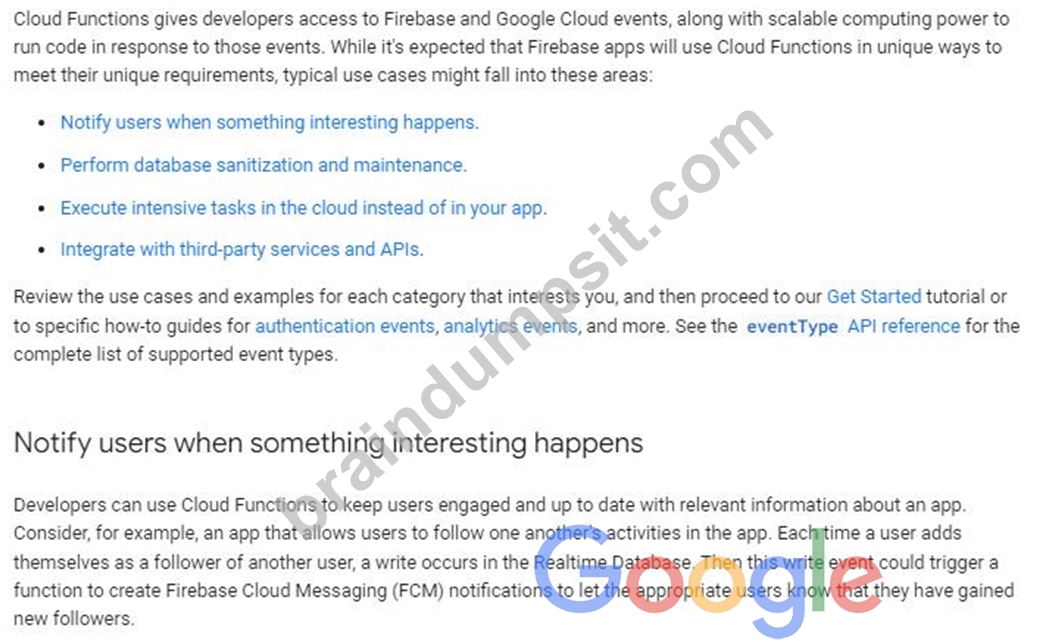
NEW QUESTION 45
You are working with a government agency. A web application serves users of the country. It al-lows citizens to receive certain services in providing their national identity. Citizens have com-plained that they are seeing delays in web page loading compared to before. On investigating, they are seeing a lot of spurious traffic coming in from a few IPs which they have identified as for-eign. What should they do?
- A. Setup Cloud Armor and add the malicious IPs to the deny list.
- B. Setup Firewall rules to allow access only to the IPs from within the country.
- C. Setup Cloud NAT and remove all the internal IPs and replace it with a single public IP.
- D. Setup Firewall rules to deny access to the malicious IPs.
Answer: A
Explanation:
Cloud Armor provides DDoS protection for applications. It can also "Filter your incoming traffic based on IPv4 and IPv6 addresses or CIDRs. Enforce geography-based access controls to allow or deny traffic based on source geo using Google's geoIP mapping."
NEW QUESTION 46
......
Use Real Dumps - 100% Free Cloud-Digital-Leader Exam Dumps: https://passguide.braindumpsit.com/Cloud-Digital-Leader-latest-dumps.html