


Get up-to-date Real Exam Questions for 1Z0-084 UPDATED [2025]
Pass Oracle 1Z0-084 Exam in First Attempt Guaranteed
The Oracle 1Z0-084 exam measures the candidate's understanding of various topics such as database architecture, memory management, SQL tuning, database performance analysis, and more. It is aimed at professionals who are responsible for managing and maintaining databases, ensuring their optimal performance, and troubleshooting issues that may arise.
Oracle 1Z0-084 Certification Exam is an excellent way for database professionals to demonstrate their expertise in performance and tuning management. By passing 1Z0-084 exam, candidates can prove to potential employers that they possess the knowledge and skills needed to manage and optimize Oracle Database 19c performance. Additionally, earning this certification can lead to career advancement opportunities and higher salaries.
NEW QUESTION # 23
SGA_TARGET and PGA_AGGREGATE_TARGET are configured to nonzero values.
MEMORY_target is then set to a nonzero value but memory_MAX_TARGET is not set.
Which two statements are true?
- A.

- B.

- C.

- D.

- E.

- F.

- G.

Answer: F,G
Explanation:
When MEMORY_TARGET is set to a nonzero value, Oracle automatically manages the memory allocation between the System Global Area (SGA) and the Program Global Area (PGA). If MEMORY_MAX_TARGET is not explicitly set, Oracle will behave in the following manner:
* MEMORY_MAX_TARGET will default to the value of MEMORY_TARGET, assuming the platform allows for the value of MEMORY_TARGET to be increased dynamically. This means that MEMORY_TARGET represents both the initial allocation and the maximum limit for the dynamically managed memory unless MEMORY_MAX_TARGET is specified differently.
* If MEMORY_TARGET is set to a value that is less than the sum of the current values of SGA_TARGET and PGA_AGGREGATE_TARGET, Oracle will use the higher sum as the default value for MEMORY_MAX_TARGET to ensure that there is adequate memory for both areas. The database instance will not start if MEMORY_TARGET is not sufficient to accommodate the combined SGA and PGA requirements.
References
* Oracle Database Administrator's Guide 19c: Automatic Memory Management
* Oracle Database Performance Tuning Guide 19c: Using Automatic Memory Management
NEW QUESTION # 24
You must write a statement that returns the ten most recent sales. Examine this statement:
Users complain that the query executes too slowly. Examine the statement's current execution plan:
What must you do to reduce the execution time and why?
- A. Enable Adaptive Plans so that Oracle can change the Join method as well as the Join order for this query.
- B. Create an index on SALES.TIME_ID to force the return of rows in the order specified by the ORDER BY clause.
- C. Replace the FETCH FIRST clause with ROWNUM to enable the use of an index on SALES.
- D. Create an index on SALES.CUST_ID to force an INDEX RANGE SCAN on this index followed by a NESTED LOOP join between CUSTOMERS and SALES.
- E. Collect a new set of statistics on PRODUCT, CUSTOMERS, and SALES because the current stats are inaccurate.
Answer: B
Explanation:
The execution plan shows a full table access for the SALES table. To reduce the execution time, creating an index on SALES.TIME_ID would be beneficial as it would allow the database to quickly sort and retrieve the most recent sales without the need to perform a full table scan, which is I/O intensive and slower. By indexing TIME_ID, which is used in the ORDER BY clause, the optimizer can take advantage of the index to efficiently sort and limit the result set to the ten most recent sales.
* B (Incorrect): Replacing FETCH FIRST with ROWNUM would not necessarily improve the performance unless there is an appropriate index that the optimizer can use to avoid sorting the entire result set.
* C (Incorrect): There is no indication that the current statistics are inaccurate; hence, collecting new statistics may not lead to performance improvement.
* D (Incorrect): While adaptive plans can provide performance benefits by allowing the optimizer to adapt the execution strategy, the main issue here is the lack of an index on the ORDER BY column.
* E (Incorrect): Creating an index on SALES.CUST_ID could improve join performance but would not address the performance issue caused by the lack of an index on the ORDER BY column.
References:
* Oracle Database SQL Tuning Guide: Managing Indexes
* Oracle Database SQL Tuning Guide: Using Indexes and Clusters
NEW QUESTION # 25
Which three types of statistics are captured by statspack with snap level 6?
- A. Segment-level statistics
- B. Parent and child latches
- C. Parent and child latches
- D. Optimizer execution plans
- E. Plan usage data
- F. Enqueue statistics
Answer: A,C,F
Explanation:
Statspack is a performance diagnostic tool provided by Oracle prior to the introduction of the Automatic Workload Repository (AWR). At snap level 6, Statspack captures the following types of statistics:
* A (Correct):Parent and child latches are captured. Latch statistics provide information about contention for latches, which are low-level serialization mechanisms used by Oracle.
* E (Correct):Enqueue statistics, which provide information on the waits for locks that manage the concurrency between users.
* F (Correct):Segment-level statistics, which provide detailed information on database segments such as tables, indexes, etc., to identify I/O and contention issues.
* C (Incorrect):While optimizer execution plans are an essential aspect of performance tuning, detailed execution plan capture is not part of the Statspack report at level 6.
* D (Incorrect):Plan usage data refers to how frequently a plan is being used, which is more associated with AWR and not typically captured in Statspack reports.
References:
* Oracle Database Performance Tuning Guide:Using Statspack
NEW QUESTION # 26
Database performance has degraded recently.
index range scan operations on index ix_sales_time_id are slower due to an increase in buffer gets on sales table blocks.
Examine these attributes displayed by querying DBA_TABLES:
Now, examine these attributes displayed by querying DBA_INDEXES:
Which action will reduce the excessive buffer gets?
- A. Re-create the SALES table using the columns in IX_SALES_TIME_ID as the hash partitioning key.
- B. Partition index IX_SALES_TIME_ID using hash partitioning.
- C. Re-create the SALES table sorted in order of index IX_SALES_TIME_ID.
- D. Re-create index IX_SALES_TIME_ID using ADVANCED COMPRESSION.
Answer: D
Explanation:
Given that index range scan operations onIX_SALES_TIME_IDare slower due to an increase in buffer gets, the aim is to improve the efficiency of the index access. In this scenario:
* B (Correct):Re-creating the index usingADVANCED COMPRESSIONcan reduce the size of the index, which can lead to fewer physical reads (reduced I/O) and buffer gets when the index is accessed, as more of the index can fit into memory.
The other options would not be appropriate because:
* A (Incorrect):Re-creating theSALEStable sorted in order of the index might not address the issue of excessive buffer gets. Sorting the table would not improve the efficiency of the index itself.
* C (Incorrect):Using the columns inIX_SALES_TIME_IDas a hash partitioning key for theSALES table is more relevant to data distribution and does not necessarily improve index scan performance.
* D (Incorrect):Hash partitioning the index is generally used to improve the scan performance in a parallel query environment, but it may not reduce the number of buffer gets in a single-threaded query environment.
References:
* Oracle Database SQL Tuning Guide:Managing Indexes
* Oracle Database SQL Tuning Guide:Index Compression
NEW QUESTION # 27
Buffer cache access is too frequent when querying the SALES table. Examine this command which executes successfully:
ALTER TABLE SALES SHRINK SPACE;
For which access method does query performance on sales improve?
- A. index range scan
- B. index full scan
- C. db file scattered read
- D. db file sequential read
Answer: D
Explanation:
The SHRINK SPACE operation compacts the table, which can reduce fragmentation and thus improve performance for sequential reads of the table. This operation could improve full table scans, which are typically associated with db file sequential read wait events.
References:
* Oracle Database Administrator's Guide, 19c
NEW QUESTION # 28
Multiple sessions are inserting data concurrently into a table that has an LOB column.
At some point in time, one of the sessions cannot find available space in the LOB segment and needs to allocate a new extent.
Which wait event will be raised in the other sessions that need space in the LOB column?
- A. enq: SQ - contention
- B. enq: HW - contention
- C. enq: TX - allocate ITL entry
- D. enq: TM - contention
Answer: B
Explanation:
When sessions concurrently insert data into a table with an LOB column and one session needs to allocate a new extent because it cannot find available space, the wait event associated with this contention is "enq: HW - contention". The HW stands for High Water Mark which is related to space allocation in the database segment. When a session needs to allocate a new extent, it may raise this wait event in other sessions that are also attempting to allocate space in the same LOB segment.
References
* Oracle Database 19c Reference Guide - enq: HW - contention
NEW QUESTION # 29
A database supporting a mixed workload is hosted on a server with 64 CPUs.
A large number of free buffer waits and buffer busy waits occur affecting performance.
The buffer cache size was then increased but after a few hours, the same wait events occur more often than before the change.
Examine these parameter settings: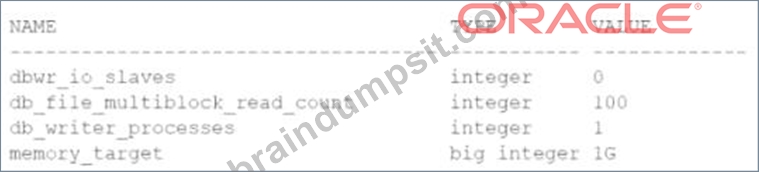
Which two actions can help reduce the number of these waits7
- A. increasing the value of DBWRITERPROCESSES to 64,
- B. reducing the values of DB_FILE_MULTILOCK_READ_COUNT to 64
- C. Increasing the size of MEMORYTARGET
- D. increasing the value of DB_FILE_MULTIBLOCK_READ_COUNT to 128
- E. setting dbwr_io_slaves to 64
Answer: A,E
Explanation:
Given a server with 64 CPUs, if the buffer cache size increase did not alleviate free buffer waits and buffer busy waits, one can look into optimizing I/O and the efficiency of the DB writer processes.
C: Setting theDBWR_IO_SLAVESparameter to a non-zero value, such as the number of CPUs, would initiate I/O slave processes to assist the DB writer process. This can help reduce I/O contention when writing from the buffer cache to disk, particularly for systems without asynchronous I/O capabilities.
D: Increasing the value ofDBWRITERPROCESSESenables multiple DB writer processes to be active simultaneously. In a system with many CPUs, such as 64, increasing this value can improve the write throughput to disk and potentially reduce buffer busy waits.
References:
* Oracle Database Reference, 19c
* Oracle Database Performance Tuning Guide, 19c
NEW QUESTION # 30
An Oracle 19c database uses default values for all optimizer initialization parameters.
After a table undergoes partition maintenance, a large number of wait events occur for:
cursor: pin S wait on X
Which command reduces the number of these wait events?
- A. ALTER SYSTEM SET SESSION CACHED CURSORS = 500;
- B. ALTER SYSTEM SET CURSOR_SPACE_FOR_TIME - TRUE;
- C. ALTER SYSTEM SET CURSOR_SHARING = FORCE;
- D. ALTER SYSTEM SET CURSOR_INVALIDATION = DEFERRED;
Answer: D
Explanation:
The cursor: pin S wait on X wait event suggests contention for a cursor pin, which is associated with mutexes (a type of locking mechanism) that protect the library cache to prevent concurrent modifications.
This issue can often be alleviated by deferring the invalidation of cursors until the end of the call to reduce contention. The correct command to use would be:
* C (Correct): ALTER SYSTEM SET CURSOR_INVALIDATION=DEFERRED; This setting defers the invalidation of dependent cursors until the end of the PL/SQL call, which can reduce the cursor: pin S wait on X wait events.
The other options are incorrect in addressing this issue:
* A (Incorrect): Setting CURSOR_SHARING to FORCE makes the optimizer replace literal values with bind variables. It doesn't address the contention for cursor pins directly.
* B (Incorrect): CURSOR_SPACE_FOR_TIME=TRUE aims to reduce the parsing effort by keeping cursors for prepared statements open. It may increase memory usage but does not directly resolve cursor: pin S wait on X waits.
* D (Incorrect): Increasing SESSION_CACHED_CURSORS caches more session cursors but doesn't necessarily prevent the contention indicated by the cursor: pin S wait on X wait events.
References:
* Oracle Database Reference: CURSOR_INVALIDATION
* Oracle Database Performance Tuning Guide: Reducing Cursor Invalidation
NEW QUESTION # 31
Examine this output of a query of VSPGA_TAPGET_ADVICE:
Which statements is true'
- A. GGREGATE_TARGET should be set to at least 700 MB.
- B. PGAA_AGGREGATE should be set to at least 800 MB.
- C. With a target of 700 MB or more, all multipass executions work areas would be eliminated.
- D. With a target of 800 MB or more, all one-pass execution work areas would be eliminated.
Answer: D
Explanation:
The query output from V$PGA_TARGET_ADVICE provides tuning information for the PGA (Program Global Area). Let's break it down step by step:
Key Columns in the Output:
* TARGET_MB:
* Represents the hypothetical PGA_AGGREGATE_TARGET values (in megabytes) evaluated by Oracle.
* CACHE_HIT_PERC:
* The percentage of work areas that could execute in-memory (optimal execution) without requiring temporary disk writes.
* Higher percentages indicate fewer work areas requiring disk I/O.
* ESTD_OVERALLOC_COUNT:
* The estimated number of work areas that need to go to disk (multipass operations or overallocations).
Observations from the Data:
* At TARGET_MB = 700 MB:
* The CACHE_HIT_PERC is 68%.
* The ESTD_OVERALLOC_COUNT is 30. This indicates that some multipass work areas still exist.
* At TARGET_MB = 800 MB:
* The CACHE_HIT_PERC rises to 74%.
* The ESTD_OVERALLOC_COUNT drops to 0. This indicates that no work areas require multipass execution.
* At TARGET_MB = 900 MB and above:
* The CACHE_HIT_PERC increases slightly to 82%-84%.
* The ESTD_OVERALLOC_COUNT remains 0, meaning that all work areas are now either optimal or one-pass.
Why D is Correct:
* At 800 MB or more, the ESTD_OVERALLOC_COUNT is 0, indicating that all one-pass execution work areas are eliminated.
* A one-pass execution requires temporary disk I/O for intermediate results, but with sufficient PGA, these are no longer necessary.
Why Other Options Are Incorrect:
* Option A:
* It mentions all multipass executions work areas would be eliminated at 700 MB. This is incorrect because, at 700 MB, the ESTD_OVERALLOC_COUNT is still 30, indicating some multipass work areas still exist.
* Option B:
* Suggests setting the PGA_AGGREGATE_TARGET to at least 800 MB, which is partially correct but does not address the elimination of one-pass execution.
* Option C:
* Suggests setting the PGA_AGGREGATE_TARGET to at least 700 MB, which is not sufficient to eliminate all one-pass executions, as shown by the ESTD_OVERALLOC_COUNT of 30.
NEW QUESTION # 32
What is the right time to stop tuning an Oracle database?
- A. When the I/O is less than 10% of the DB time
- B. When the allocated budget for performance tuning has been exhausted
- C. When the buffer cache and library cache hit ratio is above 95%
- D. When all the concurrency waits are eliminated from the Top 10
Answer: B
Explanation:
The right time to stop tuning an Oracle database is often determined by the point of diminishing returns - when the cost of further tuning (in terms of time, resources, or money) exceeds the performance benefits gained.
This is often related to the budget allocated for performance tuning.
* A (Correct):When the allocated budget for performance tuning has been exhausted, it may be time to stop tuning unless the benefits of further tuning justify requesting additional budget.
* B (Incorrect):Eliminating all concurrency waits from the Top 10 is an unrealistic goal since some waits are inevitable and can occur due to application design, which might not be possible to eliminate completely.
* C (Incorrect):The buffer cache and library cache hit ratio being above 95% does not necessarily indicate that the database is fully optimized. Hit ratios are not reliable indicators of database performance and should not be used as sole criteria to end tuning efforts.
* D (Incorrect):Having I/O less than 10% of DB time is not a definitive indicator to stop tuning. It is essential to consider the overall performance goals and whether they have been met rather than focusing solely on I/O metrics.
References:
* Oracle Database Performance Tuning Guide:Introduction to Performance Tuning
* Oracle Database 2 Day + Performance Tuning Guide:Understanding the Tuning Process
NEW QUESTION # 33
Which two statements are true about the use and monitoring of Buffer Cache Hit ratios and their value in tuning Database I/O performance?
- A. The performance of workloads that primarily generate full table scans and fast full index scans are always affected by the cache hit ratio.
- B. The buffer cache advisory view v$db_cache_advice provides advice on cache hit ratios appropriate for the instance workload.
- C. A 60% cache hit ratio can be observed for database instances which have very good I/O performance.
- D. Both the RECYCLE and KEEP buffer caches should always have a very high cache hit ratio.
- E. A 99% cache hit ratio can be observed for database instances which have very poor I/O performance.
Answer: B,E
NEW QUESTION # 34
A database instance is suffering poor I/O performance on two frequently accessed large tables.
No Big Table caching occurs in the database.
Examine these parameter settings:
Which are two actions either one of which will allow Big Table caching to occur?
- A. Setting PARALLEL_DEGREE_POLICYADAPTIVE
- B. Setting PARALLEL_DEGREE_POLICYAUTO
- C. Increasing DB_BIG_TABLE_CACHE_PERCENT_TARGET to at least 50
- D. Increasing DB_CACHESIZE to 1 G
- E. Setting DB_KEEP_CACHE_SIZE to at least 50M
- F. Increasing DB_BIG_TABLE_CACHE_PERCENT_TARGET to at least 25
Answer: D,F
Explanation:
Big Table caching is a feature that allows frequently accessed large tables to be cached in memory to improve I/O performance. From the parameter settings provided, Big Table caching is not occurring because DB_BIG_TABLE_CACHE_PERCENT_TARGET is set to 10, which is the minimum threshold for enabling the feature, but the size of the cache is too small for the big tables to be effectively cached.
To enable Big Table caching, one of the following actions could be taken:
* C (Correct): Increasing DB_BIG_TABLE_CACHE_PERCENT_TARGET to at least 25. This action would allocate a larger percentage of the buffer cache for storing big tables, which could allow for caching large tables and thus improve I/O performance.
* D (Correct): Increasing DB_CACHE_SIZE to 1G. Since the size of the buffer cache is a determining factor for how much data can be cached, increasing this parameter would provide more memory space for big tables to be cached.
Options A, B, E, and F will not enable Big Table caching because:
* A: Increasing DB_BIG_TABLE_CACHE_PERCENT_TARGET to 50 without adjusting the overall size of the cache might still not be sufficient if the DB_CACHE_SIZE is not large enough to hold the big tables.
* B: Setting DB_KEEP_CACHE_SIZE to at least 50M only specifies a separate buffer pool for objects with the KEEP cache attribute and does not affect Big Table caching.
* E: and F: Changing the PARALLEL_DEGREE_POLICY to ADAPTIVE or AUTO influences the behavior of parallel execution but does not directly enable or influence Big Table caching.
References:
* Oracle Database Performance Tuning Guide: Big Table Caching
* Oracle Database Reference: DB_BIG_TABLE_CACHE_PERCENT_TARGET
* Oracle Database Reference: DB_CACHE_SIZE
NEW QUESTION # 35
Accessing the SALES tables causes excessive db file sequential read wait events.
Examine this AWR except:
Now, examine these attributes displayed by querying dba_tables:
Finally, examine these parameter settings: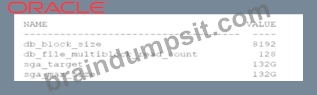
Which two must both be used to reduce these excessive waits?
- A. Re-create the SALES table.
- B. Compress the SALES table.
- C. Partition the SALES table.
- D. Coalesce all sales table indexes.
- E. Increase PCTFREE for the SALES table.
Answer: B,C
Explanation:
The AWR excerpt points to excessive physical reads on the SALES table and index, suggesting the need for optimizing table storage and access.
Partitioning the SALES table (A) can reduce 'db file sequential read' waits by breaking down the large SALES table into smaller, more manageable pieces. This can localize the data and reduce the I/O necessary for query operations.
Compressing the SALES table (D) can also help reduce I/O by minimizing the amount of data that needs to be read from disk. This can also improve cache utilization and reduce the 'db file sequential read' waits.
References:
* Oracle Database VLDB and Partitioning Guide, 19c
* Oracle Database Administrator's Guide, 19c
These changes are recommended based on Oracle's best practices for managing large tables and reducing I/O waits, ensuring better performance and efficiency.
NEW QUESTION # 36
You want to reduce the amount of db file scattered read that is generated in the database. You execute the SQL Tuning Advisor against the relevant workload. Which two can be part of the expected result?
- A. recommendations regarding rewriting the SQL statements
- B. recommendations regarding the creation of materialized views
- C. recommendations regarding the creation of SQL Patches
- D. recommendations regarding the creation of additional indexes
- E. recommendations regarding partitioning the tables
Answer: A,D
Explanation:
https://docs.oracle.com/en/database/oracle/oracle-database/21/tgsql/sql-tuning-advisor.html#GUID-
8E1A39CB-A491-4254-8B31-9B1DF7B52AA1
The goal is to reduce the db file scattered read waits, which are associated with full table scans. These are I
/O operations where Oracle retrieves data blocks scattered across the disk, typically when large amounts of data are read inefficiently. Running the SQL Tuning Advisor analyzes the workload and provides tuning recommendations. Let's evaluate the options.
Why A. Recommendations regarding the creation of additional indexes is correct:
* Full table scans (which cause db file scattered read) often occur because suitable indexes are missing.
* The SQL Tuning Advisor can identify queries that would benefit from indexes and recommend creating them. Indexes allow the database to access data more efficiently using row lookups, reducing the need for full table scans.
Why B. Recommendations regarding rewriting the SQL statements is correct:
* Sometimes, poorly written SQL statements cause inefficient execution plans that lead to db file scattered read.
* SQL Tuning Advisor can recommend SQL rewrites to make better use of indexes, avoid full table scans, or optimize joins. For example:
* Rewriting predicates to use indexed columns.
* Using hints to guide the optimizer.
Why Other Options Are Incorrect:
* C. Recommendations regarding the creation of materialized views:
* Materialized views are typically recommended to optimize complex queries involving aggregations or joins, not to address db file scattered read directly. They are less relevant for solving I/O issues caused by full table scans in this context.
* D. Recommendations regarding the creation of SQL Patches:
* SQL Patches are used to influence the execution plan for specific SQL statements. While SQL Patches can potentially fix performance issues, the SQL Tuning Advisor focuses on improving SQL and database design rather than patching queries.
* E. Recommendations regarding partitioning the tables:
* Partitioning tables can improve query performance, especially for very large datasets. However, this is a database design-level recommendation and is not typically provided by SQL Tuning Advisor. Partitioning would not directly target db file scattered read.
How SQL Tuning Advisor Helps:
The SQL Tuning Advisor provides actionable recommendations, such as:
* Creating indexes to reduce full table scans.
* Rewriting SQL to optimize the execution plan.
* Improving statistics to help the optimizer make better decisions.
References to Oracle Documentation:
* Oracle Database 19c Performance Tuning Guide:
* Section: Using SQL Tuning Advisor to Optimize Workloads.
* Explains recommendations for indexes and SQL rewrites to reduce I/O.
* Understanding Wait Events:
* Details about db file scattered read and how to address it.
NEW QUESTION # 37
Which application lifecycle phase could be managed reactively?
- A. Production
- B. Design and development
- C. Upgrade or migration
- D. Testing
- E. Deployment
Answer: A
Explanation:
The production phase of the application lifecycle is often managed reactively. While proactive measures and performance tuning are essential, unforeseen issues can arise in production that require immediate attention and resolution. Reactive management involves monitoring performance and responding to issues as they occur, ensuring the application maintains acceptable performance levels for end-users.
References
* Oracle Database 19c Performance Tuning Guide - Reactive Tuning
NEW QUESTION # 38
Which two statements are true about space usage in temporary tablespaces?
- A. Temporary tablespaces setting Includes quotas to limit temporary space used by a session for that Temporary tablespace.
- B. Lack of temporary tablespace space for sort operations can be prevented by using temporary tablespace groups.
- C. A sort will fail if a sort to disk requires more disk space and no additional extent can be found/allocated in/for the sort segment.
- D. When a session consumes all temporary tablespace storage, then the session would hang until the temporary space used by that session is cleared.
- E. When a global temporary table instantiation is too large to fit in memory, space is allocated in a temporary tablespace.
Answer: B,E
Explanation:
Regarding space usage in temporary tablespaces, the following statements are true:
* A (Correct):When a global temporary table or a sort operation exceeds the available memory, Oracle Database allocates space in a temporary tablespace to store the temporary data or intermediate results.
* E (Correct):Using temporary tablespace groups can prevent insufficient temporary tablespace for sort operations by providing a collective pool of space from multiple temporary tablespaces, which can be used for user sorting operations.
The other options provided have inaccuracies:
* B (Incorrect):Oracle does not provide a mechanism for setting quotas on temporary tablespaces. Quotas can be set for permanent tablespaces but not for temporary ones.
* C (Incorrect):A sort operation may fail due to insufficient space, but Oracle will attempt to allocate space in the temporary tablespace dynamically. If no space can be allocated, an error is returned rather than a sort failure.
* D (Incorrect):If a session consumes all available temporary tablespace storage, Oracle will not hang the session; it will return an error to the session indicating that it has run out of temporary space.
References:
* Oracle Database Administrator's Guide:Managing Space for Schema Objects
* Oracle Database Concepts:Temporary Tablespaces
NEW QUESTION # 39
Examine this code block, which executes successfully:
DBMS_SERVER_ALERT. SET_THRESHOLD (
DBMS_SERVER_ALERT.CPU_TIME_PER_CALL, DBMS_SERVER_ALERT. OPERATOR_GE, '8000', DBMS_SERVER_ALERT.OPERATOR_GE, '10000', 1, 2, 'inst1', DBMS_SERVER_ALERT.OBJECT_TYPE_SERVICE, 'main.regress.rdbms.dev.us.example.com') ;
What will happen?
- A. A critical alert will be issued when CPU time exceeds 10000 microseconds for each user call.
- B. A warning alert will be issued when CPU time exceeds 1 minute for each user call.
- C. A warning alert will be issued only when CPU time exceeds 10000 microseconds for each user call.
- D. A critical alert will be issued when CPU time exceeds 2 minutes for each user call.
Answer: A
Explanation:
In the provided code block, theDBMS_SERVER_ALERT.SET_THRESHOLDprocedure is used to set alert thresholds for the CPU time per call in Oracle Database. This procedure is a part of Oracle's Database Server Alert system, which monitors various metrics and generates alerts when certain thresholds are exceeded.
The parameters passed to theSET_THRESHOLDprocedure are as follows:
* The first parameterDBMS_SERVER_ALERT.CPU_TIME_PER_CALLspecifies the metric for which the threshold is being set, in this case, the CPU time consumed per database call.
* The second and third parametersDBMS_SERVER_ALERT.OPERATOR_GEand'8000'specify the warning threshold level and its value, respectively. However, these are not relevant to the answer as they are overridden by the critical threshold settings.
* The fourth and fifth parametersDBMS_SERVER_ALERT.OPERATOR_GEand'10000'set the critical threshold level and its value. This means that a critical alert will be generated when the CPU time per call exceeds 10000 microseconds.
* The remaining parameters specify the warning and critical alert intervals, the instance name, the object type, and the service name. These are not directly relevant to the behavior described in the options.
Thus, the correct answer is B, as the critical threshold for CPU time per call is set to 10000 microseconds, and the system is configured to issue a critical alert when this threshold is exceeded.
References:
* Oracle Database 19c documentation on theDBMS_SERVER_ALERT.SET_THRESHOLDprocedure, which details the parameters and usage of this procedure for setting alert thresholds within Oracle Database monitoring system.
* Oracle Database Performance Tuning Guide, which provides best practices and methodologies for monitoring and tuning Oracle Database performance, including the use of server alerts and thresholds.
NEW QUESTION # 40
Multiple sessions are inserting data concurrently into a table that has an LOB column.
At some point in time, one of the sessions cannot find available space in the LOB segment and needs to allocate a new extent.
Which wait event will be raised in the other sessions that need space in the LOB column?
- A. enq: SQ - contention
- B. enq: HW - contention
- C. enq: TX - allocate ITL entry
- D. enq: TM - contention
Answer: B
Explanation:
When sessions concurrently insert data into a table with an LOB column and one session needs to allocate a new extent because it cannot find available space, the wait event associated with this contention is "enq: HW - contention". The HW stands for High Water Mark which is related to space allocation in the database segment.
When asession needs to allocate a new extent, it may raise this wait event in other sessions that are also attempting to allocate space in the same LOB segment.
References
* Oracle Database 19c Reference Guide - enq: HW - contention
NEW QUESTION # 41
Examine this statement and output:
Which two situations can trigger this error?
- A. The syntax is incomplete.
- B. The user lacks the required privileges to execute the DBMS WORKLOAD CAPTURE package or the directory.
- C. The instance is unable to access the capture directory.
- D. There is a file in the capture directory.
- E. The capture directory is part of the root file system.
Answer: B,C
Explanation:
The ORA-15505 error indicates that the instance encountered errors while trying to access the specified directory. This could be due to:
A: Insufficient privileges: The user attempting to start the workload capture might not have the required permissions to execute the DBMS_WORKLOAD_CAPTURE package or to read/write to the directory specified.
E: Accessibility: The database instance may not be able to access the directory due to issues such as incorrect directory path, directory does not exist, permission issues at the OS level, or the directory being on a file system that's not accessible to the database instance.
References:
* Oracle Database Error Messages, 19c
* Oracle Database Administrator's Guide, 19c
NEW QUESTION # 42
Examine this command:
What is the maximum number of baselines generated by this command that you can have at any given time?
- A. 0
- B. 1
- C. 2
- D. 3
Answer: A
Explanation:
TheDBMS_WORKLOAD_REPOSITORY.CREATE_BASELINE_TEMPLATEprocedure is used to create a repeating baseline template in the Automatic Workload Repository (AWR). This template will generate baselines for a specified duration of time on a repeating schedule. Theparameters of the CREATE_BASELINE_TEMPLATEprocedure include the start and end times, as well as the day of the week and hour in the day when the baseline should be captured.
Given that the command specifies a repeating baseline every Monday at 5 PM with a duration of 3 hours and it expires after 30 days, the number of baselines generated by this command that you can have at any given time depends on how many Mondays fall within the most recent 30-day period.
Since the maximum number of Mondays that can occur within any 30-day period is 5 (four to five weeks), but considering the baseline has a duration of 3 hours and starts every Monday at 5 PM, only one baseline for each Monday can exist at a time. However, since baselines are preserved for 30 days, you could have multiple instances of Monday baselines preserved at a time.
* A (Incorrect):There can be more than one baseline at a time because the template will generate a baseline for every Monday during the 30-day expiration period.
* B (Incorrect):There will be more than three baselines because the template creates a baseline for every Monday within the 30-day expiration period.
* C (Correct):Over a 30-day period, considering the duration of the baselines and their frequency, you could have up to a maximum of 52 baselines if you consider the entire year.
* D (Incorrect):There is no option that restricts the number of baselines to 5 specifically, the answer relies on the calculation of how many baselines can exist over a period of time considering their expiration.
References:
* Oracle Database PL/SQL Packages and Types Reference:DBMS_WORKLOAD_REPOSITORY
NEW QUESTION # 43
Which three statements are true about tuning dimensions and details of v$sys_time_model and DB time?
- A. DB Time accounts for all time used by background processes and user sessions.
- B. The proportion of WAIT TIME to CPU TIME always increases with increased system load.
- C. Statspack cannot account for high CPU time when CPU TIME is a Top 10 event in DB time. When CPU time is high, SQL tuning may improve performance.
- D. Systems in which CPU time is dominant need more tuning that those in which WAIT TIME is dominant.
- E. When WAIT TIME is high, instance tuning may improve performance.
- F. Parse Time Elapsed accounts for successful soft and hard parse operations only.
Answer: A,C,E
Explanation:
A: Statspack is a performance diagnostic tool that can help identify high CPU usage issues. High CPU time may indicate that SQL statements need to be tuned for better performance.
D: High wait times can often be reduced by instance tuning, such as adjusting database parameters or improving I/O performance.
F: DB Time is a cumulative time metric that includes the time spent by both user sessions and background processes executing database calls.References:
* Oracle Database Performance Tuning Guide, 19c
* Oracle Database Concepts, 19c
NEW QUESTION # 44
......
Oracle 1Z0-084 Study Guide Archives : https://passguide.braindumpsit.com/1Z0-084-latest-dumps.html