


Get VMware 2V0-41.24 Dumps Questions Study Exam Guide Jun 23, 2025
2V0-41.24 Premium Exam Engine - Download Free PDF Questions
NEW QUESTION # 48
A company Is deploying NSX micro-segmentation in their vSphere environment to secure a simple application composed of web. app, and database tiers.
The naming convention will be:
- WKS-WEB-SRV-XXX
- WKY-APP-SRR-XXX
- WKI-DB-SRR-XXX
What is the optimal way to group them to enforce security policies from NSX?
- A. Do a service insertion to accomplish the task.
- B. Use Edge as a firewall between tiers.
- C. Group all by means of tags membership.
- D. Create an Ethernet based security policy.
Answer: C
Explanation:
Tags are metadata that can be applied to physical servers, virtual machines, logical ports, and logical segments in NSX. Tags can be used for dynamic security group membership, which allows for granular and flexible enforcement of security policies based on various criteria. In the scenario, the company is deploying NSX micro-segmentation to secure a simple application composed of web, app, and database tiers.
NEW QUESTION # 49
Match the NSX Intelligence recommendations with their correct purpose.
Answer:
Explanation:
NEW QUESTION # 50
An NSX administrator would like to export syslog events that capture messages related to NSX host preparation events.
Which message ID (msgid) should be used in the syslog export configuration command as a filter?
- A. FABRIC
- B. SYSTEM
- C. GROUPING
- D. MONITORING
Answer: A
Explanation:
In NSX, the FABRIC message ID is used to capture and export syslog events related to host preparation and other fabric-related activities. These events are important for tracking and troubleshooting the setup and configuration of NSX components across the fabric, including host preparation events.
NEW QUESTION # 51
Which troubleshooting step will resolve an error with code 1001 during the configuration of a time- based firewall rule?
- A. Reinstalling the NSX VIBs on the ESXi host.
- B. Restarting the NTPservice on the ESXi host.
- C. Reconfiguring the ESXI host with a local NTP server.
- D. Changing the lime zone on the ESXi host.
Answer: B
Explanation:
According to the web search results, error code 1001 is related to a time synchronization issue between the ESXi host and the NSX Manager. This can cause problems when configuring a time-based firewall rule, which requires the ESXi host and the NSX Manager to have the same time zone and NTP server settings. To resolve this error, you need to restart the NTP service on the ESXi host to synchronize the time with the NSX Manager. You can use the following command to restart the NTP service on the ESXi host:
/etc/init.d/ntpd restart
The other options are not valid solutions for this error. Reinstalling the NSX VIBs on the ESXi host will not fix the time synchronization issue. Changing the time zone on the ESXi host may cause more discrepancies with the NSX Manager. Reconfiguring the ESXi host with a local NTP server may not be compatible with the NSX Manager's NTP server.
NEW QUESTION # 52
Which CLI command on NSX Manager and NSX Edge is used to change NTP settings?
- A. set timezone
- B. set ntp-server
- C. get time-server
- D. get timezone
Answer: B
Explanation:
The set ntp-server command is used on NSX Manager and NSX Edge to configure the NTP (Network Time Protocol) settings. This command allows administrators to specify the NTP server, ensuring that the NSX components synchronize their time accurately with the designated time server.
NEW QUESTION # 53
Which command is used to set the NSX Manager's logging-level to debug mode for troubleshooting?
- A. Set service manager logging-level debug
- B. Set service nsx-manager logging-level debug
- C. Set service manager log-level debug
- D. Set service nsx-manager log-level debug
Answer: A
Explanation:
According to the VMware Knowledge Base article 1, the CLI command to set the log level of the NSX Manager to debug mode is set service manager logging-level debug. This command can be used when the NSX UI is inaccessible or when troubleshooting issues with the NSX Manager1. The other commands are incorrect because they either use a wrong syntax or a wrong service name. The NSX Manager service name is manager, not nsx-manager2. The log level parameter is logging-level, not log- level3.
https://kb.vmware.com/s/article/55868
NEW QUESTION # 54
When deploying an NSX Edge Transport Node, what two valid IP address assignment options should be specified for the TEP IP addresses? (Choose two.)
- A. Use a Static IP List
- B. Use an IP Pool
- C. Use BootP
- D. Use RADIUS
- E. Use a DHCP Server
Answer: A,B
Explanation:
When deploying an NSX Edge Transport Node, two valid IP address assignment options that should be specified for the TEP IP addresses are Use an IP Pool and Use a Static IP List. These options allow the user to assign TEP IP addresses from a predefined range of IP addresses or a manually entered list of IP addresses, respectively345. The other options are incorrect because they are not supported methods for assigning TEP IP addresses. There is no option to use a DHCP server, RADIUS, or BootP for TEP IP address assignment in NSX-T345.
Reference: NSX-T Edge TEP networking options, Multi-TEP High Availability, Create an IP Pool for Host Tunnel Endpoint IP Addresses
NEW QUESTION # 55
Which three security features are dependent on the NSX Application Platform? (Choose three.)
- A. NSX Malware Prevention
- B. NSX Firewall
- C. NSX Distributed IDS/IPS
- D. NSX Intelligence
- E. NSX Network Detection and Response
- F. NSX TLS Inspection
Answer: A,D,E
NEW QUESTION # 56
What are three NSX Manager roles? (Choose three.)
- A. zookeepet
- B. master
- C. manager
- D. controller
- E. policy
- F. cloud
Answer: C,D,E
Explanation:
According to the VMware NSX 4.x Professional documents and tutorials, an NSX Manager is a standalone appliance that hosts the API services, the management plane, control plane, and policy management. The NSX Manager has three built-in roles: policy, manager, and controller2. The policy role handles the declarative configuration of the system and translates it into desired state for the manager role. The manager role receives and validates the configuration from the policy role and stores it in a distributed persistent database. The manager role also publishes the configuration to the central control plane. The controller role implements the central control plane that computes the network state based on the configuration and topology information3. The other roles (master, cloud, and zookeeper) are not valid NSX Manager roles.
NEW QUESTION # 57
How does virtual networking enable business to reduce time-to-market?
- A. By performing automatic hardware upgrades
- B. By providing network services on demand
- C. By removing physical network devices
- D. By increasing traffic bandwidth
Answer: B
NEW QUESTION # 58
Which two logical router components span across all transport nodes? (Choose two.)
- A. DISTRIBUTED_ROUTER_TIER1
- B. SERVICE_ROUTER_TIER1
- C. DISTRIBUTED_ROUTER_TIER0
- D. TIER0_DISTRIBUTED_ROUTER
- E. SERVICE_ROUTER_TIER0
Answer: A,D
Explanation:
TIER0_DISTRIBUTED_ROUTER: The Tier-0 Distributed Router spans all transport nodes, providing distributed routing capabilities across the NSX environment at the Tier-0 level.
DISTRIBUTED_ROUTER_TIER1: Similarly, the Tier-1 Distributed Router spans all transport nodes, enabling distributed routing at the Tier-1 level, which allows routing functions to occur closer to the workload VMs across the transport nodes.
NEW QUESTION # 59
Which of the following statements is true regarding the use of a Dynamic Routing Protocol on a Tier-1 Gateway?
- A. A Dynamic Routing Protocol cannot be used on a Tier-1 Gateway.
- B. You can only use BGP on the Tier-1 Gateway.
- C. You can only use OSPF on the Tier-1 Gateway
- D. Both BGP and OSPF can be used on a Tier-1 Gateway.
Answer: B
Explanation:
In NSX, BGP is the only supported dynamic routing protocol on a Tier-1 Gateway. OSPF is not supported at the Tier-1 level; it is only available on Tier-0 Gateways. This limitation means that for dynamic routing on a Tier-1 Gateway, administrators can configure BGP to exchange routing information with connected Tier-0 Gateways.
NEW QUESTION # 60
An NSX administrator is using ping to check connectivity between VM1 running on ESXi1 to VM2 running on ESXi2. The ping tests fails. The administrator knows the maximum transmission unit size on the physical switch is 1600.
Which command does the administrator use to check the VMware kernel ports for tunnel end point communication?
- A. esxcli network diag ping -I vmk0O -H <destination IP address>
- B. vmkping ++netstack=vxlan -d -s 1572 <destination IP address>
- C. vmkping ++netstack=geneve -d -s 1572 <destination IP address>
- D. esxcli network diag ping -H <destination IP address>
Answer: C
Explanation:
The command vmkping ++netstack=geneve -d -s 1572 <destination IP address> is used to check the VMware kernel ports for tunnel end point communication. This command uses the geneve netstack, which is the default netstack for NSX-T. The -d option sets the DF (Don't Fragment) bit in the IP header, which prevents the packet from being fragmented by intermediate routers. The -s
1572 option sets the packet size to 1572 bytes, which is the maximum payload size for a geneve encapsulated packet with an MTU of 1600 bytes. The <destination IP address> is the IP address of the remote ESXi host or VM.
Reference: : VMware NSX-T Data Center Installation Guide, page 19. : VMware Knowledge Base:
Testing MTU with the vmkping command (1003728). : VMware NSX-T Data Center Administration Guide, page 102.
NEW QUESTION # 61
An administrator needs to encrypt file transfers between two sites that do not have the same subnet. Which NSX-T feature accomplishes this task?
- A. SSL VPN +
- B. L2 VPN
- C. IPSEC VPN
- D. Tier-0 Gateway
Answer: C
NEW QUESTION # 62
An administrator has deployed 10 Edge Transport Nodes in their NSX Environment, but has forgotten to specify an NTP server during the deployment.
What is the efficient way to add an NTP server to all 10 Edge Transport Nodes?
- A. Use a PowerCU script
- B. Use the CU on each Edge Node
- C. Use a Node Profile
- D. Use Transport Node Profile
Answer: C
Explanation:
A node profile is a configuration template that can be applied to multiple NSX Edge nodes or transport nodes at once. A node profile can include settings such as NTP server, DNS server, syslog server, and so on1. By using a node profile, an administrator can efficiently configure or update the network settings of multiple NSX Edge nodes or transport nodes in a single operation2. The other options are incorrect because they are either not efficient or not supported. Using the CLI on each Edge node would require manual and repetitive commands for each node, which is not efficient. Using a Transport Node Profile would not work, because a Transport Node Profile is used to configure the NSX-T Data Center components on a transport node, such as the transport zone, the N- VDS, and the uplink profiles3. Using a PowerCLI script might work, but it would require writing and testing a custom script, which is not as efficient as using a built-in feature like a node profile.
https://docs.vmware.com/en/VMware-NSX/4.1/administration/GUID-B4AE1432-690E-480E-91C4-
903C1E549C23.html?hWord=N4IghgNiBcIHYHsAmBTABABwE4IGYEsIUQBfIA
NEW QUESTION # 63
What needs to be configured on a Tier-0 Gateway to make NSX Edge Services available to a VM on a VLAN-backed logical switch?
- A. Loopback Router Port
- B. Downlink interface
- C. VLAN Uplink
- D. Service interface
Answer: D
Explanation:
A Service interface on the Tier-0 Gateway is required to make NSX Edge Services, such as NAT or load balancing, available to a VM on a VLAN-backed logical switch. The Service interface allows the Tier-0 Gateway to connect directly to the VLAN-backed network, enabling Edge Services to interact with VMs on that network.
NEW QUESTION # 64
Which CLI command shows syslog on NSX Manager?
- A. show log manager follow
- B. get log-file syslog
- C. /var/log/syslog/syslog.log
- D. get log-file auth.lag
Answer: B
Explanation:
According to the VMware NSX CLI Reference Guide, this CLI command shows the syslog messages on the NSX Manager node. You can use this command to view the system logs for troubleshooting or monitoring purposes.
The other options are either incorrect or not available for this task. get log-file auth.log is a CLI command that shows the authentication logs on the NSX Manager node, not the syslog messages.
/var/log/syslog/syslog.log is not a CLI command, but a file path that may contain syslog messages on some Linux systems, but not on the NSX Manager node. show log manager follow is not a valid CLI command, as there is no show log command or manager option in the NSX CLI.
## NSX Cli command get log-file <fiilename>
get log-file <filename> follow
# Below are commonly used log files, there are many more log files
get log-file <auth.log | controller | controller-error | http.log | kern.log | manager.log | node-mgmt.log | policy.log | syslog> [follow]
# use [follow] to continuing monitor Example: get log-file syslog follow get log-file syslog
NEW QUESTION # 65
An administrator needs to download the support bundle for NSX Manager.
Where does the administrator download the log bundle from?
- A. System > Support Bundle
- B. System > Settings
- C. System > Utilities > Tools
- D. System > Settings > Support Bundle
Answer: A
Explanation:
To download the support bundle for NSX Manager, an administrator navigates to System > Support Bundle in the NSX Manager UI. This section provides options to generate and download the log bundle, which contains diagnostic information useful for troubleshooting and support.
NEW QUESTION # 66
DRAG DROP
Refer to the exhibits.
Drag and drop the NSX graphic element icons on the left found in an NSX Intelligence visualization graph to Its correct description on the right.
Answer:
Explanation: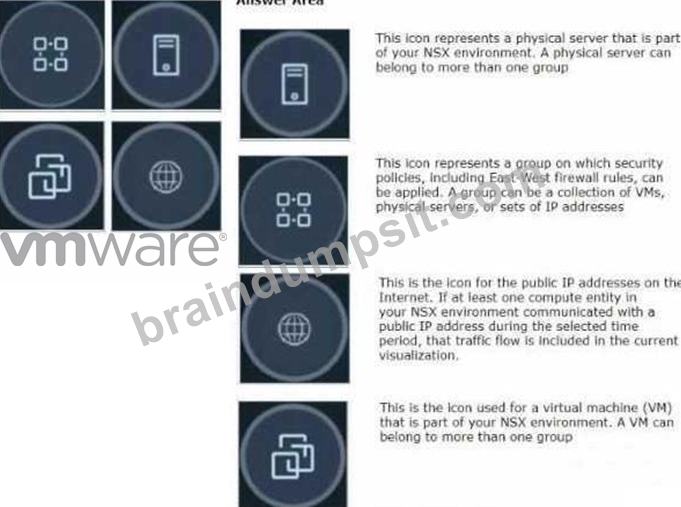
Explanation:
https://docs.vmware.com/en/VMware-NSX-Intelligence/4.0/user-guide/GUID-DC78552B-2CC4-410D- A6C9-3FE0DCEE545B.html
NEW QUESTION # 67
Which command is used to display the network configuration of the Tunnel Endpoint (TEP) IP on a bare metal transport node?
- A. ifconfig
- B. tepconfig
- C. debug
- D. tcpdump
Answer: A
Explanation:
The command ifconfig is used to display the network configuration of the Tunnel Endpoint (TEP) IP on a bare metal transport node2. The TEP IP is assigned to a network interface on the bare metal server that is used for overlay traffic. The ifconfig command can show the IP address, netmask, broadcast address, and other information of the network interface. For example, the following command shows the network configuration of the TEP IP on a bare metal transport node with interface name ens192:
ifconfig ens192
The output of the command would look something like this:
ens192: flags=4163<UP,BROADCAST,RUNNING,MULTICAST> mtu 1500 inet 10.10.10.10 netmask
255.255.255.0 broadcast 10.10.10.255 inet6 fe80::250:56ff:fe9a:1b8c prefixlen 64 scopeid 0x20<link> ether 00:50:56:9a:1b:8c txqueuelen 1000 (Ethernet) RX packets 123456 bytes 123456789 (123.4 MB) RX errors 0 dropped 0 overruns 0 frame 0 TX packets 234567 bytes 234567890 (234.5 MB) TX errors 0 dropped 0 overruns 0 carrier 0 collisions 0 The TEP IP in this example is 10.10.10.10.
Reference: IBM Cloud Docs
NEW QUESTION # 68
......
Free 2V0-41.24 Exam Braindumps VMware Pratice Exam: https://passguide.braindumpsit.com/2V0-41.24-latest-dumps.html